Planning a trip abroad in 2026? Whether you’re backpacking through Southeast Asia, exploring South American cities, or navigating remote European villages, one question inevitably bubbles up: Is the tap water safe to drink? The anxiety around water quality can put a serious damper on your travel experience, forcing you to rely on expensive bottled water or risk unpleasant—and potentially dangerous—illnesses. Fortunately, the next generation of filtered water bottles has transformed from simple carbon straws into sophisticated purification systems that fit in your daypack. This comprehensive guide dives deep into what makes a filtered water bottle truly effective for international travel, helping you understand the technology, features, and certifications that separate reliable purification from marketing hype.
Top 10 Filtered Water Bottles for International Tap Water
Detailed Product Reviews
1. LifeStraw Go Series Water Filter Bottle - BPA-Free, Removes Bacteria, Parasites, Microplastics, Improves Taste, 22oz, Aegean Sea

Overview: The LifeStraw Go Series is a rugged, adventure-ready water filter bottle designed for travelers, hikers, and anyone concerned about water safety. This 22-ounce BPA-free bottle combines a membrane microfilter with activated carbon to remove biological contaminants and improve taste. It’s engineered for filling up from questionable sources—airport bathrooms, foreign taps, or roadside stops—making it ideal for international travel and outdoor expeditions where water quality is uncertain.
What Makes It Stand Out: The dual-filter system is exceptional: the membrane microfilter eliminates 99.999999% of bacteria, 99.999% of parasites, and microplastics down to 0.2 microns for up to 1,000 gallons (about five years of daily use). The carbon filter tackles chlorine, odors, and chemical taste for up to 26 gallons. This combination of biological and aesthetic filtration is rare in portable bottles, providing true peace of mind in challenging environments.
Value for Money: At $39.54, it’s a premium investment that pays dividends for adventure seekers. The five-year membrane lifespan translates to roughly $8 per year for biological protection—far cheaper than buying bottled water abroad. While replacement carbon filters add cost, the bottle replaces 8,000 single-use plastics, making it environmentally and economically sound for frequent travelers compared to disposable options.
Strengths and Weaknesses: Strengths: Unparalleled biological filtration; extremely long-lasting membrane filter; improves both safety and taste; robust build for rugged use; massive environmental impact. Weaknesses: Higher upfront cost; carbon filter requires frequent replacement; smaller 22oz capacity; requires strong suction; not dishwasher safe.
Bottom Line: The LifeStraw Go Series is the top choice for international travelers and outdoor enthusiasts who prioritize safety over convenience. If you’re visiting regions with questionable water quality, this bottle is worth every penny.
2. Brita Hard-Sided Plastic Premium Filtering Water Bottle, BPA-Free, Reusable, Replaces 300 Plastic Water Bottles, Filter Lasts 2 Months or 40 Gallons, Includes 1 Filter, Night Sky - 26 oz.

Overview: Brita’s 26-ounce hard-sided bottle offers a practical entry point into filtered hydration for everyday use. This BPA-free plastic bottle targets taste and odor improvements rather than biological threats, making it perfect for city dwellers concerned with municipal water quality. The Night Sky colorway provides a sleek, modern aesthetic while the push-button lid and carrying loop prioritize convenience for gym-goers, students, and commuters.
What Makes It Stand Out: The design excellence sets it apart: a one-handed push-button operation, leak-proof construction, and top-rack dishwasher safety make it effortlessly maintainable. The activated carbon block filter reduces chlorine and particulates as you sip, eliminating the waiting period required by pitcher systems. The built-in straw delivers smooth flow without tipping, ideal for driving or multitasking.
Value for Money: At $17.99, it’s one of the most affordable filtered bottles available. Each $5-7 replacement filter covers 40 gallons or two months, costing about 15 cents per gallon. While it only replaces 300 plastic bottles per filter (less than competitors), the low entry price makes it accessible. For tap water that’s already microbiologically safe, this delivers excellent value versus buying premium bottled water.
Strengths and Weaknesses: Strengths: Extremely affordable; user-friendly design; dishwasher safe; leak-proof; widely available replacement filters; good flow rate; lightweight. Weaknesses: Not a purifier—doesn’t remove bacteria or parasites; limited contaminant reduction; plastic construction less durable; filter lifespan shorter than premium options.
Bottom Line: Brita’s bottle is perfect for everyday urban use where water is already safe but tastes unpleasant. It’s a budget-friendly, convenient solution for improving tap water flavor without replacing countless disposable bottles.
3. Survimate 5-Stage 0.01μm Ultra-Filtration Filtered Water Bottle, BPA-Free Material, NSF/ANSI 42&372 Certified, Portable Water Filter Bottle for Survival, Camping, Hiking, and Emergency Use

Overview: Survimate’s 5-stage filtered bottle bridges the gap between everyday convenience and survival preparedness. This BPA-free bottle employs an impressive 0.01-micron hollow fiber UF membrane—five times finer than typical filters—making it suitable for camping, hiking, and emergency scenarios. NSF/ANSI certifications validate its claims, while the built-in compass reinforces its outdoor focus for adventurers who demand reliable hydration off-grid.
What Makes It Stand Out: The filtration precision is remarkable: the 0.01μm membrane removes 99.99% of harmful substances including heavy metals, sediment, and organic matter. The five-stage system (coarse screen, UF membrane, PP membrane, purification beads, activated carbon) provides comprehensive protection beyond basic carbon filters. The integrated compass is a clever addition for wilderness navigation, eliminating one extra piece of gear.
Value for Money: Priced at $25.99, it offers mid-range value with premium filtration. The 1,500-liter (396-gallon) filter lifespan replaces approximately 3,000 plastic bottles, delivering substantial environmental savings. Cost per gallon is extremely low over its lifetime. While not the cheapest option, it provides advanced filtration comparable to more expensive survival bottles, making it a smart choice for outdoor enthusiasts who need more than taste improvement.
Strengths and Weaknesses: Strengths: Superior 0.01μm filtration; NSF certified; built-in compass; long 1,500L filter life; comprehensive contaminant reduction; excellent for wilderness use. Weaknesses: Not dishwasher safe; requires strong suction due to dense filtration; initial carbon particles in first use; may clog with very turbid water; compass durability uncertain.
Bottom Line: Survimate is ideal for campers and hikers needing serious filtration without the LifeStraw price tag. It’s a reliable companion for backcountry adventures where water sources are questionable but not severely contaminated.
4. PURIFYXX HydroBottle | Stainless Steel Filtered Water Bottle, 24 oz | BPA-Free, Removes Lead, Chlorine, Arsenic, VOCs | Filter Lasts 3 Months, Replaces 568 Plastic Bottles (Black)
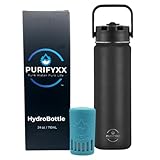
Overview: The PURIFYXX HydroBottle distinguishes itself with a stainless steel construction and American manufacturing, targeting health-conscious consumers worried about heavy metals. This 24-ounce bottle removes over 80 contaminants including lead, arsenic, and VOCs—substances that many competitors ignore. It’s designed for daily urban use, with a sleek form factor that fits car cup holders and professional environments where plastic bottles feel inappropriate.
What Makes It Stand Out: American craftsmanship and metal construction provide durability and temperature retention absent in plastic alternatives. The dual-straw system (full-length for everyday use, short for filtered drinking) offers versatility. The advanced leak-proof flip lid allows filling without removal—surprisingly convenient for water fountains and sinks. Most importantly, it tackles heavy metals and chemical contaminants that basic carbon filters miss, addressing serious health concerns in aging infrastructure.
Value for Money: At $32.09, it’s competitively priced for a stainless steel filtered bottle. The three-month filter lifespan replaces 568 plastic bottles, offering better environmental returns than basic Brita models. While replacement filter costs aren’t specified, the premium for metal construction and heavy metal filtration is justified for those in areas with older pipes or industrial contamination. It’s a middle-ground option between basic taste filters and premium purification systems.
Strengths and Weaknesses: Strengths: Stainless steel durability; removes lead/arsenic/VOCs; made in USA; dual straw system; excellent leak-proof lid; cupholder-friendly; addresses serious contaminants. Weaknesses: Unknown replacement filter cost; no biological pathogen removal; slightly smaller capacity; heavier than plastic; limited third-party certification details.
Bottom Line: Choose the HydroBottle if you’re concerned about chemical contaminants and heavy metals in municipal water. Its stainless steel build and serious filtration make it perfect for urban professionals in older cities.
5. Brita Hard-Sided Plastic Premium Filtering Water Bottle, BPA-Free, Reusable, Replaces 300 Plastic Water Bottles, Filter Lasts 2 Months or 40 Gallons, Includes 1 Filter, Blush - 26 oz

Overview: This Blush-colored variant of Brita’s popular 26-ounce filtered bottle delivers the same practical hydration solution with a softer aesthetic. Designed for everyday use where water is microbiologically safe but aesthetically unappealing, this BPA-free bottle targets chlorine taste and odor reduction. It’s an accessible entry point for students, office workers, and fitness enthusiasts seeking to reduce bottled water consumption without complex maintenance requirements.
What Makes It Stand Out: The Blush colorway offers a stylish alternative to utilitarian designs, appealing to users who want function with fashion. Like its Night Sky sibling, it features Brita’s proven one-handed push-button lid, leak-proof construction, and top-rack dishwasher safety—amenities that simplify daily routines. The activated carbon block filter works instantly as you sip, eliminating the need to wait for gravity filtration, while the built-in carrying loop enhances portability.
Value for Money: At $17.24, it’s slightly cheaper than the Night Sky version, making it an even better value. The math remains compelling: each $5-7 replacement filter processes 40 gallons for roughly 15 cents per gallon. While it only replaces 300 plastic bottles per filter—less than survival-oriented competitors—the extremely low entry cost means you’ll break even after avoiding just 30-40 disposable bottles. For municipal tap water improvement, it’s among the most economical options available.
Strengths and Weaknesses: Strengths: Most affordable option; stylish Blush color; dishwasher safe; proven leak-proof design; widely available filters; lightweight plastic; smooth drinking straw. Weaknesses: No biological contaminant removal; limited to taste/odor/particulates; plastic less durable long-term; shorter filter lifespan than premium models; not suitable for wilderness.
Bottom Line: The Blush Brita bottle is perfect for cost-conscious consumers prioritizing convenience and taste improvement. If your tap water is safe but unpalatable, this delivers excellent everyday value with minimal investment.
6. LifeStraw Go Series – BPA-Free Water Filter Bottle for Travel and Everyday Use Removes Bacteria, Parasites and Microplastics, Improves Taste, 1L Aegean Sea

Overview: The LifeStraw Go Series 1L bottle is a portable water purification system designed for adventurous travelers and daily commuters who prioritize safety. This Aegean Sea-colored BPA-free bottle combines generous capacity with advanced two-stage filtration, enabling users to safely fill up from airport bathrooms, foreign taps, or gas stations while eliminating up to 8,000 single-use plastic bottles from circulation.
What Makes It Stand Out: The membrane microfilter’s extraordinary 1,000-gallon lifespan—approximately five years—distinguishes it dramatically from competitors. It removes 99.999999% of bacteria including E.coli, 99.999% of parasites like Giardia, and 99.999% of microplastics, offering true purification rather than simple taste enhancement. The 1-liter capacity reduces refill frequency, while the carbon filter improves taste for up to 26 gallons.
Value for Money: At $37.05, this bottle represents exceptional long-term value. The membrane filter alone justifies the price, lasting five years and replacing thousands of plastic bottles. While the carbon filter requires bimonthly replacement, the overall cost-per-gallon remains far below purchasing bottled water, paying for itself within months for regular users.
Strengths and Weaknesses: Strengths: Unmatched filtration performance; extraordinarily durable membrane filter; large 1L capacity; genuine travel-ready purification; significant environmental impact Weaknesses: Carbon filter needs replacement every two months; plastic construction less durable than metal; flow rate slows over time; higher initial investment than basic filters
Bottom Line: For international travelers, hikers, or anyone facing questionable water quality, the LifeStraw Go Series is indispensable. Its superior filtration capabilities and remarkable longevity make it the definitive choice for portable water safety.
7. Brita Stainless Steel Premium Filtering Water Bottle, BPA-Free, Reusable, Insulated, Replaces 300 Plastic Water Bottles, Filter Lasts 2 Months or 40 Gallons, Includes 1 Filter, Carbon - 20 oz

Overview: The Brita Stainless Steel Premium Filtering Bottle delivers convenient, great-tasting water in a sleek, insulated package. This 20-ounce BPA-free bottle features double-wall construction that keeps drinks cold for 24 hours, making it ideal for daily commutes, gym sessions, and office use. It focuses on improving taste and reducing common contaminants from municipal water sources.
What Makes It Stand Out: The combination of premium stainless steel insulation and Brita’s trusted filtration technology creates a superior everyday hydration experience. The activated carbon block filter effectively reduces chlorine taste and odor while decreasing particulates. The thoughtful design includes an easy-sip straw, one-handed push-button lid, built-in carrying loop, and leakproof construction, prioritizing convenience without sacrificing performance.
Value for Money: At $31.49, this bottle positions itself as a mid-range premium option. Each filter replaces 300 single-use plastic bottles and lasts 40 gallons or two months—longer than many competitors. The durable stainless steel construction ensures years of use, while the insulation eliminates need for disposable cold drinks, creating strong value for daily users.
Strengths and Weaknesses: Strengths: Excellent 24-hour cold retention; durable stainless steel build; user-friendly design with straw and one-handed operation; trusted Brita filtration; leakproof construction Weaknesses: Filters only improve taste and reduce particulates—doesn’t purify; 20oz capacity may be small for some; replacement filters add ongoing cost; not suitable for untreated water sources
Bottom Line: For those seeking better-tasting tap water on the go, the Brita Stainless Steel bottle excels. Its insulation, build quality, and convenience features make it perfect for daily use, though it’s not designed for backcountry purification needs.
8. PHILIPS Water Bottle with Filter, Filter Water Bottle Stainless Steel with GoZero Everyday BPA-Free Tap Water Filter, Water Filter Bottle Keep Drink Cold 24 Hours, 1 Filter for 40 gal / 2 Months

Overview: The Philips GoZero Everyday Filtered Bottle offers accessible, great-tasting water in a practical stainless steel design. This bottle targets daily hydration needs with activated carbon fiber filtration that reduces chlorine and particulates from tap water. Its 24-hour cold retention and user-friendly features make it suitable for gym-goers, commuters, and travelers seeking improved water taste without purification claims.
What Makes It Stand Out: Philips combines health-conscious materials with practical convenience at an aggressive price point. The 18/8 food-grade stainless steel construction ensures safety, while the silicone mouthpiece enables smooth sipping. Top-rack dishwasher safety (excluding filter) simplifies cleaning, and the cup-holder-friendly design with built-in carry loop enhances portability. The pop-up lid allows true one-handed operation.
Value for Money: At just $20.97, this bottle offers exceptional affordability without compromising core features. The filter lasts 40 gallons or two months, replacing hundreds of plastic bottles. The stainless steel insulation and durable construction provide premium features typically found in higher-priced competitors, making it an outstanding budget-conscious choice for everyday use.
Strengths and Weaknesses: Strengths: Highly affordable; quality stainless steel insulation; dishwasher-safe convenience; excellent portability features; effective taste improvement Weaknesses: Carbon filter only—no purification capability; limited to treated tap water; brand less established in filtration; filter replacement adds ongoing expense
Bottom Line: The Philips GoZero is a fantastic value for everyday tap water improvement. Its combination of stainless steel durability, insulation, and user-friendly design at under $21 makes it ideal for budget-minded consumers seeking better hydration without purification needs.
9. LifeStraw Go Series – BPA-Free Water Filter Bottle for Travel and Everyday use removes Bacteria, parasites and microplastics, Improves Taste, 1L 2-Pack; Nordic Noir and Clear

Overview: The LifeStraw Go Series 2-Pack delivers twin purification power for couples, families, or individuals wanting backup. Each 1-liter BPA-free bottle provides the same advanced two-stage filtration as the single version, removing bacteria, parasites, and microplastics while improving taste. The Nordic Noir and Clear color options offer aesthetic variety while maintaining identical performance capabilities for shared adventures.
What Makes It Stand Out: This package doubles the exceptional LifeStraw filtration technology at a reduced per-unit cost. Each membrane microfilter lasts 1,000 gallons (five years), removing 99.999999% of bacteria, 99.999% of parasites, and microplastics. The carbon filters improve taste for 26 gallons each. The 2-pack configuration eliminates 16,000 single-use plastic bottles total, amplifying environmental impact while ensuring you always have a clean bottle ready.
Value for Money: At $84.95 for two bottles ($42.48 each), the 2-Pack offers modest savings over individual purchases. The immense value comes from the membrane filters’ five-year lifespan, making this a long-term investment for households. For traveling couples or parent-child pairs, having two purification bottles justifies the upfront cost within one major trip, eliminating bottled water expenses.
Strengths and Weaknesses: Strengths: Twin bottles for shared use; identical superior filtration; significant long-term savings; massive environmental impact; perfect for traveling pairs Weaknesses: Higher upfront cost; carbon filters need frequent replacement; plastic construction; may be excessive for solo users; requires commitment to long-term use
Bottom Line: The LifeStraw 2-Pack is ideal for duos who prioritize water safety. Whether for couples traveling abroad or parents preparing emergency kits, the combined filtration power and per-unit savings make this a smart investment for shared purification needs.
10. LifeStraw Go Series — Insulated Stainless Steel Water Filter Bottle for Travel and Everyday Use Removes Bacteria, Parasites and Microplastics, Improves Taste, 24oz Laguna Teal

Overview: The LifeStraw Insulated Stainless Steel bottle merges ultimate water purification with temperature control. This 24-ounce Laguna Teal bottle combines LifeStraw’s renowned two-stage filtration with double-wall insulation, keeping water cold while removing bacteria, parasites, and microplastics from virtually any freshwater source. It’s designed for travelers who refuse to compromise on safety or refreshment.
What Makes It Stand Out: This model uniquely pairs LifeStraw’s exceptional membrane microfilter (1,000 gallons/five years) with stainless steel insulation. It removes 99.999999% of bacteria, 99.999% of parasites, and microplastics while maintaining 24-hour cold retention. The durable construction withstands rugged travel, and the carbon filter improves taste for 26 gallons. No other bottle combines this level of purification with premium temperature control.
Value for Money: At $50.78, this represents LifeStraw’s premium tier, justified by the stainless steel construction and insulation. The five-year membrane filter lifespan delivers exceptional per-gallon value, replacing 8,000 plastic bottles. For adventure travelers needing both purification and temperature retention, the price premium over plastic models is worthwhile and cost-effective long-term.
Strengths and Weaknesses: Strengths: Unmatched purification plus insulation; durable stainless steel build; true travel-ready performance; long-lasting membrane filter; superior taste improvement Weaknesses: Highest price in LifeStraw lineup; carbon filter requires bimonthly replacement; heavier than plastic versions; 24oz capacity smaller than 1L plastic model
Bottom Line: For serious travelers and outdoor enthusiasts wanting both purification and insulation, this bottle is unmatched. The premium materials and dual functionality justify the higher cost, making it the ultimate companion for adventures where water quality and temperature matter equally.
Why Filtered Water Bottles Are Essential for International Travel
Gone are the days when a simple charcoal stick could protect you from the full spectrum of global water contaminants. Modern travel demands more robust solutions because water quality varies dramatically not just between countries, but between neighborhoods within the same city. A 2026 filtered water bottle serves as your personal mobile water treatment plant, removing everything from chlorine and heavy metals to bacteria, protozoa, and even viruses in some advanced models. Unlike buying single-use plastic bottles—which devastate local environments and drain your travel budget—these reusable systems provide unlimited safe drinking water while reducing your carbon footprint. For the conscious traveler, they’re as essential as your passport.
Understanding Global Water Quality Variations
Water contamination isn’t a monolithic problem. In many developing regions, microbial pathogens like E. coli, Giardia, and Cryptosporidium pose the primary threat, often resulting from inadequate sanitation infrastructure. Meanwhile, industrialized nations might have perfectly microbiologically safe water but suffer from aging pipes leaching lead, excess fluoride, or disinfection byproducts like trihalomethanes. Agricultural runoff introduces pesticides and nitrates in rural areas, while urban centers battle microplastic contamination. Your filtered bottle needs to address the specific cocktail of contaminants present in your destination, which means understanding the difference between filtration, purification, and simple taste improvement.
Health Risks of Untreated Tap Water Abroad
Traveler’s diarrhea affects up to 70% of international travelers depending on destination, but that’s just the tip of the iceberg. Waterborne pathogens can cause hepatitis A, typhoid fever, cholera, and dysentery—illnesses that can derail months of planning and land you in a foreign hospital. Even “mild” contamination can trigger chronic gastrointestinal issues that linger long after you’ve returned home. Chemical contaminants present different, slower-burning risks: prolonged lead exposure affects neurological function, while arsenic—a common issue in parts of Asia and South America—can cause serious long-term health problems. The right filtered bottle acts as a critical barrier between you and these invisible threats.
How Modern Filter Technology Works
The filtration landscape has evolved dramatically, with 2026 models employing multi-stage systems that target different contaminant types. Understanding these mechanisms helps you cut through marketing jargon and identify genuinely effective systems. The most sophisticated bottles now combine physical barriers with chemical adsorption and, in some cases, electroadsorption or UV-C light integration for comprehensive protection.
Mechanical Filtration vs. Chemical Purification
Mechanical filtration physically blocks contaminants based on pore size, measured in microns. For context, bacteria typically range from 0.2 to 2 microns, while viruses can be as small as 0.02 microns. A filter rated to 0.1 microns will catch most bacteria and protozoa but may miss viruses, which is why true “purifiers” incorporate additional technologies. Chemical purification uses substances like iodine, chlorine dioxide, or advanced oxidation processes to neutralize microbes. However, chemical methods can leave unpleasant tastes and don’t remove particulates or heavy metals. The best travel bottles combine both approaches: mechanical filtration for clarity and chemical/adsorptive media for comprehensive contaminant removal.
The Role of Activated Carbon and Ion Exchange
Activated carbon remains the gold standard for improving taste and removing chemical contaminants, but not all carbon is created equal. Coconut shell-based activated carbon offers superior adsorption capacity compared to wood or coal-derived versions, effectively grabbing chlorine, volatile organic compounds (VOCs), and some pesticides. Ion exchange resins work differently, swapping harmful ions (like lead or copper) for harmless ones (typically sodium or potassium). This technology is crucial for heavy metal removal, especially in regions with aging infrastructure. In 2026 models, you’ll find enhanced carbon blocks with embedded ion exchange beads, creating a single, more efficient filtration stage.
Key Features to Evaluate in 2026 Models
When comparing filtered water bottles for international use, several critical features determine real-world performance. Don’t be swayed by sleek designs alone—dig into the specifications that impact safety, convenience, and longevity. The market has segmented into specialized categories, from ultralight backpacking models to urban-focused bottles that prioritize taste improvement alongside microbial protection.
Filtration Capacity and Lifespan
Filter lifespan is measured in liters or gallons and varies wildly—from 100 liters for basic models to over 4,000 liters for advanced hollow fiber systems. Consider your trip duration and daily consumption. A two-week trip consuming 3 liters daily requires at least 42 liters of capacity, but you’ll want substantial buffer for unexpected extensions. More importantly, understand what “end of life” means: does the filter simply clog, or does it allow contaminants to pass through? Look for filters with built-in shut-off mechanisms that prevent use beyond safe capacity, rather than those that gradually degrade in performance.
Flow Rate and Drinking Experience
A filter that removes everything but requires Herculean suction to drink from quickly becomes shelfware. Flow rate—measured in liters per minute—impacts your hydration experience significantly. Advanced 2026 models have addressed this with larger filter surface areas and optimized channel designs, achieving flow rates of 1 liter per minute or better while maintaining tight filtration specs. Some feature squeeze bottles that force water through the filter faster, while others use gravity-fed systems for camp use. Test the drinking resistance if possible; you shouldn’t feel like you’re doing a workout just to quench your thirst.
Material Safety and Durability
Your bottle’s construction matters as much as its filter. Tritan copolyester offers glass-like clarity and durability without BPA, while food-grade stainless steel provides superior impact resistance and temperature insulation. Avoid bottles with interior linings or paints that could leach chemicals, especially when exposed to heat. For extreme travel, consider bottles with protective silicone sleeves that prevent cracking and provide grip. The threading where the lid meets the bottle is a common failure point—look for robust, wide-thread designs that can withstand repeated opening and closing without stripping.
Size, Weight, and Portability Considerations
A 1-liter bottle might seem ideal until you’re hauling it through airport security and crowded markets. Many 2026 travelers opt for 500-650ml bottles that fit in standard cup holders and pack easily, supplementing with larger collapsible reservoirs when needed. Weight becomes critical for backpackers—every ounce counts when you’re carrying your world on your back. Ultralight models weigh under 200 grams empty, while feature-rich purifiers might hit 400 grams. Consider whether the bottle fits in your daypack’s side pocket and whether its shape is conducive to one-handed operation, which is invaluable when navigating unfamiliar terrain.
Certification Standards That Matter
Marketing claims are meaningless without third-party verification. In 2026, several certification bodies provide reliable benchmarks for filter performance, and understanding their protocols helps you make informed decisions. Don’t trust vague claims like “removes 99.9% of contaminants”—demand specific, testable certifications.
NSF/ANSI Ratings Explained
NSF International develops standards that filters are tested against. NSF/ANSI 42 covers aesthetic effects (taste, odor, chlorine), while NSF/ANSI 53 addresses health-related contaminants like lead and VOCs. For international travel, NSF/ANSI P231 or P248 are crucial—they test microbiological water purifiers against bacteria, viruses, and protozoa using real-world conditions. A bottle claiming NSF P231 certification has been rigorously tested with actual pathogenic microbes, not just surrogates. Some manufacturers go further, obtaining NSF/ANSI 401 certification for emerging contaminants like pharmaceuticals and pesticides, which is increasingly relevant in developing urban areas.
EPA Protocols for Microbiological Purifiers
The EPA’s Guide Standard and Protocol for Testing Microbiological Water Purifiers represents the gold standard for virus removal claims. If a bottle claims to remove viruses—a critical feature in regions with hepatitis A or norovirus contamination—it should meet EPA standards. This involves testing against three specific viruses (poliovirus, rotavirus, and MS2 coliphage) and demonstrating at least 4-log (99.99%) reduction. Be wary of products that claim virus removal based solely on pore size; true viral protection requires more than mechanical filtration alone.
Design Innovations in 2026
This year’s filtered water bottles showcase remarkable engineering advances that address longstanding travel pain points. From integrated sensors to sustainable materials, manufacturers are reimagining what a portable water system can be.
Smart Technology Integration
Several 2026 models feature NFC chips or Bluetooth connectivity that sync with smartphone apps to track filter life, water consumption, and even local water quality databases. Some advanced bottles include turbidity sensors that detect when water is too cloudy for effective filtration, alerting you to pre-filter or find alternative sources. While these features add cost and battery concerns, they provide peace of mind in high-risk areas. Consider whether you want tech integration or prefer the simplicity of mechanical indicators—there’s no point in a smart bottle if its battery dies mid-trek.
Sustainable and Eco-Friendly Materials
Sustainability has moved from marketing buzzword to core design principle. Many 2026 bottles use recycled ocean plastics for their housings, while filters themselves are increasingly recyclable through manufacturer take-back programs. Some brands have eliminated disposable filter cartridges entirely, creating cleanable, reusable filter elements that last for years with proper maintenance. Look for B Corp certified manufacturers or those with transparent supply chain auditing, ensuring your purchase doesn’t contribute to the environmental problems you’re trying to solve.
Maintenance and Care Best Practices
Even the best filtered bottle fails if improperly maintained. International travel subjects your bottle to varied water qualities, temperatures, and usage patterns that can accelerate fouling or bacterial growth in the bottle itself. Establishing a care routine is as important as choosing the right model.
Cleaning Protocols for Optimal Performance
Backflushing—forcing clean water backward through the filter—removes trapped particulates and extends filter life. Most hollow fiber filters require backflushing after every use in turbid water, while carbon-based systems need less frequent maintenance. The bottle itself needs regular cleaning with mild soap, paying special attention to the mouthpiece where bacteria from your mouth can colonize. Some 2026 models feature dishwasher-safe components or UV-C equipped lids that sterilize the interior between uses. Never use hot water with hollow fiber membranes unless specified—it can permanently damage the pore structure.
When to Replace Your Filter Cartridge
Filter life indicators range from simple date wheels to electronic counters, but these are estimates based on average water quality. If you’re filtering visibly cloudy water or water with high sediment, lifespan decreases significantly. Signs of filter exhaustion include dramatically reduced flow rate, unusual tastes returning, or visible damage to the filter element. For critical travel, carry a spare cartridge and replace proactively rather than pushing the limits. A filter that fails in a high-risk region isn’t saving money—it’s inviting disaster.
Budget Considerations and Value Proposition
Price points for 2026 filtered water bottles span from $30 to over $200, creating a spectrum of features and performance levels. Understanding the true cost involves more than the sticker price—it’s about cost per liter, replacement cartridge availability, and the value of your health.
Initial Investment vs. Long-Term Savings
A $150 bottle with a 3,000-liter filter costs $0.05 per liter, while a $40 bottle with a 100-liter cartridge costs $0.40 per liter plus frequent replacements. Factor in the cost of bottled water at $1-5 per liter in tourist areas, and even expensive bottles pay for themselves within weeks of travel. More importantly, consider the cost of traveler’s diarrhea medication, lost travel days, or medical treatment. From this perspective, a premium purifier is cheap insurance.
Warranty and Customer Support Factors
International travelers need manufacturers with global support networks. A lifetime warranty means little if you can’t get a replacement shipped to Kathmandu. Look for brands with international distribution, clear warranty terms for travel-related damage, and responsive customer service across time zones. Some companies offer expedition insurance—if your filter fails in the field, they’ll expedite a replacement to your location. Read warranty fine print carefully; many exclude damage from freezing, which is a real risk if you’re traveling through varied climates.
Traveling with Your Filtered Bottle: Practical Tips
Navigating airport security with a filtered bottle requires strategy. Empty the bottle before security, but keep it easily accessible—some inspectors want to examine the filter element separately. Once through, fill at water fountains in the terminal rather than buying overpriced bottled water. During your trip, use the cleanest water source available; pre-filtering through a bandana extends filter life dramatically. In restaurants, politely ask staff to fill your bottle from their filtered water source rather than tap—the gesture is often appreciated and ensures safer water. Remember that filtration doesn’t create water; in arid regions, pair your bottle with a water storage bladder to carry larger quantities from reliable sources.
Frequently Asked Questions
1. Can filtered water bottles remove viruses from tap water in developing countries? Standard filters cannot remove viruses due to their tiny size. You need a purifier certified to EPA standards that combines mechanical filtration with chemical disinfection, electroadsorption, or UV-C treatment. Always check for explicit virus removal claims backed by third-party testing, especially when traveling to regions with hepatitis A or norovirus risks.
2. How do I know when my filter cartridge actually needs replacement, not just when the indicator says so? Trust your senses alongside the indicator. If water flow becomes noticeably slower, tastes or smells return to pre-filtration levels, or the water remains cloudy after filtering, replace the cartridge immediately. For critical travel, replace after filtering any visibly contaminated water, regardless of remaining capacity. The indicator is a guide, not a guarantee.
3. Are filtered bottles effective against pharmaceuticals and microplastics in tap water? Many 2026 models with NSF/ANSI 401 certification can reduce emerging contaminants including pharmaceuticals, pesticides, and microplastics down to about 0.5 microns. However, removal rates vary significantly by specific compound. For comprehensive protection, choose bottles that combine activated carbon with ultrafiltration membranes and explicitly list these contaminants in their performance data sheets.
4. What’s the difference between a water filter and a water purifier for travel purposes? Filters remove bacteria and protozoa mechanically but typically can’t catch viruses. Purifiers meet EPA standards for virus removal through multiple technologies. For international tap water where viral contamination is possible, a purifier is the safer choice. The terminology matters—don’t assume a “filter” protects against viruses unless it specifically states purifier-level certification.
5. Can I use my filtered bottle with hot tap water or for coffee and tea? Never use hot water unless the manufacturer explicitly approves it, as heat can damage filter membranes and cause chemical leaching. For hot beverages, filter cold water first, then heat it separately. Some stainless steel models can handle warm water for cleaning, but the filter element itself should only process water at room temperature or colder to maintain integrity.
6. How should I clean my bottle when traveling in areas with questionable water quality? Clean the bottle body regularly with soap and safe water (either pre-filtered or boiled). For the filter element, backflush with clean water after each use in turbid conditions. If the mouthpiece contacts contaminated water, sanitize it with alcohol wipes or a diluted bleach solution (1 teaspoon per liter of water), rinsing thoroughly afterward. Never boil the filter element unless designed for it.
7. Will airport security confiscate my filtered water bottle? Empty bottles typically pass through security without issues, but some inspectors may want to examine the filter element separately. Pack it where it’s easily accessible, and consider carrying the product manual or a printed certification to explain its purpose. Arrive early to allow for potential additional screening, especially with larger or more complex purifier models.
8. How do I handle freezing temperatures with my filtered bottle? Water expands when freezing, which can rupture filter membranes permanently. In cold climates, sleep with your bottle in your sleeping bag and keep it insulated during the day. If freezing is unavoidable, remove the filter element and store it in a warm place, using the bottle as a standard container until temperatures rise. Some manufacturers offer cold-weather filters, but most standard models are vulnerable to freeze damage.
9. Are there any tap water contaminants that filtered bottles cannot remove? No portable system removes 100% of all contaminants. Dissolved salts (like seawater), certain heavy metals in high concentrations, and radioactive particles typically require reverse osmosis or distillation. Additionally, very small viruses may slip through filters not certified as purifiers. Always research destination-specific water issues and consider your bottle as one layer of protection, not a universal solution.
10. How do I dispose of used filter cartridges responsibly while traveling? Many manufacturers now offer take-back programs—save used cartridges and mail them back when you return home. If this isn’t feasible, seal used cartridges in a plastic bag and dispose of them in proper waste facilities, not in natural environments. Some carbon-based filters can be opened, with the carbon composted and the plastic housing recycled where facilities exist. Never burn filter cartridges, as they may release toxic compounds.'