Packing for an international adventure in 2026 looks drastically different than it did just five years ago. Between the proliferation of USB-C powered laptops, tablets that rival desktop computers, and smart luggage with built-in charging capabilities, the modern traveler’s arsenal of electronics demands sophisticated power solutions. Add in the complexity of varying electrical standards across continents, and choosing the right travel adapter becomes less of an afterthought and more of a critical pre-trip decision that can make or break your connectivity on the road.
The landscape of travel adapters has evolved far beyond simple plug converters. Today’s options incorporate gallium nitride technology for faster charging, intelligent power distribution systems, and safety features that protect your expensive devices from unpredictable foreign electrical grids. Whether you’re planning a multi-country European rail journey, a business trip through Asia-Pacific, or a remote work stint across South America, understanding what separates a reliable adapter from a disappointing one will save you from dead devices, fried electronics, and frantic airport purchases.
Top 10 International Travel Adapters
Detailed Product Reviews
1. EPICKA Universal Travel Adapter, European Travel Plug Adapter (Not a Voltage Converter) - International Power Adapter Worldwide Charger with USB-C & 4 USB-A Ports, Travel Essentials (TA-105, Grey)

Overview: The EPICKA TA-105 is a comprehensive 6-in-1 universal travel adapter designed for globetrotters. It covers over 200 countries with four integrated plug types and can charge up to six devices simultaneously through its combination of AC socket, four USB-A ports, and one USB-C port. This grey unit is built for travelers juggling multiple electronics across continents.
What Makes It Stand Out: This adapter’s standout feature is its ability to power six devices at once, making it ideal for families or tech-heavy travelers. The built-in 10A fuse exceeds many competitors, and the comprehensive safety certifications (RoHS, CE, FCC) combined with safety shutters and plug lock system provide exceptional peace of mind. The 1100W-2400W capacity handles most travel electronics efficiently.
Value for Money: Priced competitively for a universal adapter, the EPICKA offers strong value by eliminating the need for multiple country-specific adapters. The 2-year limited warranty and 30-day money-back guarantee exceed industry standards, while the robust safety features prevent costly device damage. Compared to buying separate adapters, it pays for itself on one multi-country trip.
Strengths and Weaknesses: Strengths:
- Charges six devices simultaneously
- Comprehensive global coverage (200+ countries)
- Superior 10A fuse protection
- Strong safety certifications and features
- Generous warranty period
Weaknesses:
- Not a voltage converter (cannot support high-power heating appliances)
- Bulkier than single-region adapters
- USB-C port limited to 3A (no Power Delivery)
- Cannot be used in South Africa or India
Bottom Line: The EPICKA TA-105 is an excellent all-in-one solution for international travelers with multiple devices, provided you understand its voltage limitations and don’t need ultra-fast USB-C charging.
2. Ceptics Universal Travel Adapter, 45W International Power Adapter with PD & QC 3.0 Dual USB-C, 3 USB Travel Adapter Worldwide, Type I C G A Outlets 110V 220V A/C - EU Euro US UK (11-KU)

Overview: The Ceptics 11-KU positions itself as a premium universal adapter with advanced charging capabilities. Supporting Type A, I, C, and G outlets, it powers five devices simultaneously through three USB-A ports and two USB-C ports, one featuring 45W Power Delivery and Quick Charge 3.0. Designed in the USA, it targets tech-savvy travelers needing rapid charging.
What Makes It Stand Out: The 45W Power Delivery USB-C port is the star feature, capable of charging laptops and fast-charging modern smartphones at maximum speed. The dual USB-C configuration is rare in this category, and the Quick Charge 3.0 support ensures Android devices charge optimally. The brand’s claim as “#1 travel adapter” reflects its focus on complete, safe charging solutions with FCC, CE, and RoHS certifications.
Value for Money: While priced higher than basic adapters, the Ceptics justifies its cost through genuine fast-charging capabilities that eliminate need for separate laptop chargers. The 8A fuse protection and comprehensive safety system protect expensive devices, making it cost-effective for professionals traveling with high-value electronics. The included spare fuse adds long-term value.
Strengths and Weaknesses: Strengths:
- 45W Power Delivery USB-C port for laptop charging
- Quick Charge 3.0 support for Android devices
- Dual USB-C ports for modern device compatibility
- Comprehensive safety certifications
- Spare fuse included
Weaknesses:
- 8A fuse lower than some competitors (10A)
- Not a voltage converter
- Brand’s “#1” claim is unverified
- Premium price point
- Confusing product description with typos
Bottom Line: The Ceptics 11-KU is worth the investment for business travelers and digital nomads who need fast laptop charging and multiple USB-C devices powered simultaneously across continents.
3. Anker Nano Travel Adapter, 5-Port Power Adapter with 1× 2-Pin AC, 2 USB A, 2 USB C for 20W, Smart Temperature Control, Works in 200+ Countries, Not a Voltage Converter, Travel Essentials (1-Pack)

Overview: Anker’s Nano Travel Adapter prioritizes portability without sacrificing functionality. This 5-in-1 adapter covers 200+ countries with type A, C, G, and I plugs, delivering 20W total power across two USB-C ports, two USB-A ports, and one AC outlet. Its 43% size reduction and foldable pins make it exceptionally travel-friendly for minimalist packers.
What Makes It Stand Out: The revolutionary compact design sets this adapter apart—it’s substantially smaller than competitors while maintaining full functionality. The 2-pin to 2-pin connection enhances safety by preventing electric shocks, and Anker’s renowned temperature control technology protects devices. The foldable and retractable pins eliminate snagging in luggage, a common frustration with universal adapters.
Value for Money: Anker commands a slight premium, but the engineering excellence and reliability justify the cost. The 18-month warranty and Anker’s stellar customer service reputation provide peace of mind. For travelers prioritizing luggage space, the size reduction alone offers value that outweighs marginally higher price versus bulkier alternatives.
Strengths and Weaknesses: Strengths:
- Exceptionally compact and lightweight
- Foldable, retractable pins prevent damage
- Anker’s reliable temperature control
- 2-pin safety design
- Strong brand reputation and warranty
Weaknesses:
- Only 20W total output limits multi-device charging speed
- 2-pin AC outlet restricts some 3-pin devices
- No Power Delivery or Quick Charge
- Cannot charge power-hungry laptops effectively
- Premium price for lower power output
Bottom Line: The Anker Nano is perfect for light-traveling professionals and minimalists who value space savings and brand reliability over high-power charging capabilities.
4. European Travel Plug Adapter USB C, HANYCONY International Plug Adapter, US to Europe Adapter Plug 2 Outlets 3 USB Ports(2 C Port), Type C Power Adapter to Italy Spain France Portugal Iceland Germany

Overview: The HANYCONY adapter is a specialized European Type C solution offering 5-in-1 functionality for US travelers visiting the continent. It provides two standard American AC outlets plus three USB ports (two USB-C, one USB-A) in a compact 2.2×1.1×1.5-inch form factor. Designed specifically for European voltage standards, it supports up to 2500W through its AC outlets.
What Makes It Stand Out: This adapter’s dual USB-C ports cater to modern travelers with multiple USB-C devices, a feature often missing in Europe-specific adapters. The smart charging technology automatically detects devices for optimal charging efficiency, while the cruise ship-friendly design (no surge protection) ensures compliance with maritime regulations. The LED power indicator is a practical addition for verifying operation.
Value for Money: Positioned as a mid-range option, the HANYCONY delivers excellent value for Europe-focused travelers. The dual USB-C configuration eliminates need for separate chargers for phones, tablets, and wireless headphones. The 12-month warranty is adequate, and the specialized design means you’re not paying for global plugs you’ll never use on a European vacation.
Strengths and Weaknesses: Strengths:
- Dual USB-C ports for modern devices
- Cruise ship approved (no surge protection)
- Ultra-compact and lightweight (2.4 oz)
- Smart charging technology
- LED power indicator
Weaknesses:
- Europe-only compatibility (Type C)
- Total USB output limited to 15.5W (slow for multiple devices)
- Not a voltage converter
- No ground connection
- Cannot be used in UK, Ireland, or Scotland
Bottom Line: The HANYCONY is an excellent choice for travelers exclusively visiting Europe who need multiple USB-C ports and cruise ship compliance in a pocket-sized package.
5. 2 Pack European Plug Adapter USB C, TESSAN US to Europe Adapter 4 Outlets 3 USB Charger, Type C International Power Adaptor to Italy Spain France Portugal Iceland Germany, Europe Travel Essentials

Overview: The TESSAN 2-pack offers exceptional value for European travelers, providing two complete 7-in-1 adapters, each featuring four AC outlets, one USB-C port, and two USB-A ports. Designed for Type C European sockets, these adapters support 2500W max power and can charge seven devices simultaneously, making them ideal for families or groups traveling together across continental Europe.
What Makes It Stand Out: The four-sided outlet design prevents blocking adjacent plugs—a common issue with cube adapters—while the 2-pack configuration provides unmatched value for multi-room hotel stays or group travel. The USB-C port delivers 15W max, and USB-A ports provide 2.4A each, offering balanced charging for mixed device ecosystems. The no-surge-protection design ensures cruise ship compatibility.
Value for Money: This 2-pack represents the best value proposition in the Europe adapter category. Getting two fully-featured adapters for the price of one premium universal adapter is remarkable. The ability to charge seven devices per unit means families can share one adapter while keeping another as backup or for separate hotel rooms, eliminating the need for multiple purchases.
Strengths and Weaknesses: Strengths:
- Exceptional 2-pack value
- Four AC outlets per adapter
- Non-blocking four-sided design
- Cruise ship approved
- Compact size for the outlet count
Weaknesses:
- Europe-only (Type C)
- USB-C limited to 15W (no fast charging)
- Not a voltage converter
- No ground connection
- Build quality less premium than single-unit competitors
Bottom Line: The TESSAN 2-pack is the smartest buy for families, groups, or cruise passengers heading to Europe, delivering outstanding versatility and value despite modest USB charging speeds.
6. decqle Universal Travel Adapter, International Travel Plug Adapter with 2 USB-C(PD 20W) & 1 USB-A Ports, All in One Portable Adaptor, for USA, UK, EU, AU & 224+ Countries (White) US

Overview: The decqle Universal Travel Adapter positions itself as a comprehensive solution for global travelers, supporting an impressive 224+ countries through four interchangeable plug types (C, G, A, I). This all-in-one unit combines AC power pass-through with modern USB charging capabilities, including two USB-C ports with 20W Power Delivery and one USB-A port. At just 148 grams and measuring 7.6×5.3×5.9cm, it packs substantial functionality into a pocket-sized form factor designed for serious international travelers.
What Makes It Stand Out: The adapter’s standout feature is its exceptional country coverage, surpassing most competitors with support for 224+ destinations. The dual USB-C PD 20W ports enable simultaneous fast charging of modern smartphones and tablets, while the intelligent power distribution chip optimizes charging across multiple devices. Safety is clearly prioritized with eight protection mechanisms including over-temperature, overvoltage, and short-circuit protection, plus a spare 8A fuse for backup. The retractable pin design with side-button release prevents damage during storage.
Value for Money: Priced competitively within the premium travel adapter segment, the decqle offers strong value for frequent international travelers who need maximum country compatibility. The inclusion of two USB-C PD ports and comprehensive safety features justifies the cost compared to basic adapters. However, the 2000W AC limit and 20W USB-C cap may require power users to purchase additional equipment for high-draw appliances or laptops needing more wattage.
Strengths and Weaknesses: Strengths include unmatched country coverage, dual PD 20W USB-C ports, comprehensive safety protections, compact cube design, and spare fuse inclusion. Weaknesses are the critical exclusion of Type D and M plugs (India, South Africa, Korea), lack of voltage conversion requiring dual-voltage appliances, potential plug looseness in non-supported regions, and the 20W USB limit restricting charging speed for larger devices.
Bottom Line: The decqle adapter excels for travelers visiting mainstream destinations across Europe, Asia, and the Americas. Its safety features and dual USB-C ports make it ideal for charging modern devices, but verify your destination’s plug type and your appliances’ voltage requirements before purchasing. Avoid if traveling to India, South Africa, or South Korea.
7. TESSAN Universal Travel Adapter, International Power Adapter with 2 USB C 2 USB A Ports, Travel Plug Adaptor Worldwide for US to Europe UK Italy Ireland Australia France Germany(Type C G A I)

Overview: TESSAN delivers a practical 5-in-1 charging solution for international travelers with coverage across 150+ countries. This adapter features four USB ports (two USB-C and two USB-A) alongside a universal AC outlet, allowing simultaneous charging of five devices. The unit accepts 100-250V input and supports up to 2500W for AC-powered devices. Weighing just 5.2 ounces with dimensions of 2.53×2.15×1.97 inches, it balances portability with multi-device functionality for business and leisure travelers alike.
What Makes It Stand Out: The adapter’s cruise ship approval (no surge protection, no cords) makes it uniquely valuable for maritime travelers. Its four USB ports provide versatile charging options, with USB-C ports delivering 15W each and USB-A ports offering 12W, totaling 20W max output. The integrated security shutters and dual 10A fuse protection system demonstrate thoughtful safety engineering. The compact rectangular design fits efficiently in luggage, while the simple slide-out plug mechanism ensures quick transitions between regions.
Value for Money: This adapter hits the sweet spot for price-conscious travelers needing reliable multi-device charging. While USB power delivery is modest compared to PD-enabled competitors, the four-port configuration and 2500W AC capacity offer excellent utility for the price. It eliminates the need for separate USB chargers, potentially saving money and luggage space. For those prioritizing device charging over high-speed laptop power, the value proposition is compelling.
Strengths and Weaknesses: Strengths include cruise ship compatibility, four USB ports, compact design, 2500W AC capacity, dual fuse protection, and broad country support. Weaknesses are lower USB-C power output (15W max) limiting fast-charging capabilities, no Power Delivery for newer devices, 20W total USB limit when multiple ports are used, and lack of voltage conversion requiring dual-voltage appliances.
Bottom Line: The TESSAN adapter is an excellent choice for cruise passengers and travelers charging multiple smartphones, tablets, and cameras. Its safety features and AC capacity handle most travel scenarios, but power users needing laptop charging or maximum USB speed should look elsewhere. Perfect for families or groups traveling together.
8. Acer Universal Travel Plug Adapter - International Power Adapter with 5 USB Ports (3 USB C) 5.8A, Worldwide Outlet Charger for USA to European UK France Germany Spain, Type C/E/F/G/I/L/A, Black

Overview: Acer’s 6-in-1 universal adapter targets device-heavy travelers with an impressive array of five USB ports (three USB-C and two USB-A) plus a universal AC outlet. Supporting over 150 countries with plug types C, E, F, G, I, L, and A, it enables simultaneous charging of six devices. The unit delivers 28W total USB output with individual USB-C ports providing 3.0A/15W and USB-A ports offering 2.4A/12W. Measuring 2.0×2.2×3.0 inches, this black adapter emphasizes USB charging capacity in a compact, cruise ship-approved design.
What Makes It Stand Out: The three USB-C ports distinguish this adapter in a market where most competitors offer only one or two. This configuration is ideal for travelers with multiple modern devices like smartphones, tablets, wireless earbuds, and power banks. The cruise ship compatibility (no surge protection, cord-free) addresses a specific travel niche. Acer’s brand reputation adds reliability confidence, while the 5.8A total USB capacity ensures reasonable charging speeds across all ports when used simultaneously.
Value for Money: For travelers carrying numerous USB-powered devices, this adapter delivers exceptional value by consolidating multiple chargers into one unit. The three USB-C ports alone justify the price premium over basic adapters. While 15W per USB-C port won’t maximize laptop charging speeds, it’s sufficient for overnight device charging. The 2500W AC outlet capability (implied by similar products) adds versatility for dual-voltage appliances, making it a cost-effective all-in-one solution.
Strengths and Weaknesses: Strengths include three USB-C ports, five total USB ports, cruise ship approval, compact size, broad country compatibility, and brand reliability. Weaknesses are modest 15W USB-C output limiting fast charging, no Power Delivery protocol, potential heat generation with five devices, unclear AC power rating in specifications, and lack of voltage conversion requiring dual-voltage appliances.
Bottom Line: This Acer adapter is tailor-made for tech-savvy travelers prioritizing USB charging capacity over raw AC power. It’s perfect for families or individuals with multiple devices, especially cruise passengers. However, business travelers needing laptop fast-charging should consider PD-enabled alternatives. An excellent consolidation tool for reducing charger clutter.
9. Travel Adapter USB C, Universal All in One Worldwide Travel Adapter Fast Charge GaN PD3.0 Type C USB-A Quick Charging Ports Power Converters Wall Charger AC Power Plug Adapter for USA EU UK AUS Black

Overview: This universal travel adapter leverages GaN (Gallium Nitride) technology to deliver fast charging in an ultra-compact package. Supporting over 150 countries with US/EU/UK/AU plugs, it features a 20W PD3.0 USB-C port alongside USB-A ports for versatile device charging. The unit incorporates critical safety features including built-in shutters, dual 8A fuses, and multiple protection systems. Weighing only 3.2 ounces with dimensions of 3.0×1.9×1.5 inches, it’s among the smallest full-feature adapters available, designed for minimalist travelers and cruise ship use.
What Makes It Stand Out: The GaN technology enables higher efficiency and reduced heat generation in a smaller footprint than traditional silicon-based adapters. The PD3.0 20W USB-C port provides genuine fast charging for compatible smartphones and tablets, significantly outpacing standard USB ports. The detachable plug system converts between five input configurations, offering flexibility while maintaining a secure connection that won’t fall out of outlets. Comprehensive safety features including over-current, over-voltage, and surge protection exceed basic adapter standards.
Value for Money: This adapter competes aggressively in the fast-charging segment, offering GaN technology and PD3.0 at a mid-range price point. The compact size and weight savings alone justify the cost for frequent travelers. While USB port count is limited compared to multi-port alternatives, the charging speed advantage compensates for travelers with one or two primary devices. The robust safety features and build quality provide long-term value, potentially outlasting cheaper alternatives.
Strengths and Weaknesses: Strengths include GaN technology, PD3.0 20W fast charging, ultra-compact design, lightweight construction (3.2oz), comprehensive safety protections, dual fuses, and cruise ship compatibility. Weaknesses are unspecified total USB output capacity, limited number of USB ports, ambiguous AC power rating, potential plug durability concerns with detachable system, and lack of voltage conversion requiring dual-voltage appliances.
Bottom Line: Ideal for solo travelers and minimalists prioritizing fast charging and portability over multi-device capacity. The GaN technology and PD3.0 support make it excellent for iPhone and Android users needing quick power boosts. Verify your destination’s plug type and confirm your devices support dual voltage before purchasing. A smart choice for carry-on only travelers.
10. 2 Pack European Travel Plug Adapter, International Power Plug Adapter with 3 Outlets 3 USB Charging Ports(1 USB C), Type C Plug Adapter Travel Essentials to Most Europe EU Spain Italy France Germany
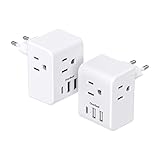
Overview: This two-pack adapter set specifically targets European travelers, converting a single Type C outlet into three standard American outlets plus three USB charging ports (one USB-C and two USB-A). Each adapter supports up to 2500W (250V, 10A) for AC devices and delivers 3.1A total USB output with smart charging technology. The compact units measure 3.0×2.4×1.6 inches and feature power indicators. Designed for most European countries except the UK and Ireland, this set provides excellent value for couples, families, or multi-room hotel stays.
What Makes It Stand Out: The two-pack configuration is the primary differentiator, offering redundancy and multi-room capability at a price point typically charged for a single adapter. The three AC outlets per adapter effectively create a mini power strip, allowing travelers to use multiple US appliances simultaneously. The USB-C port supports up to 3A charging, while smart technology optimizes power delivery across devices. The set’s country-specific focus ensures perfect plug fit in supported European outlets without the wobble common with universal adapters.
Value for Money: Exceptional value for European-centric travelers, essentially providing two adapters for the price of one. The ability to charge six devices per adapter (three AC + three USB) eliminates need for separate power strips and USB chargers, saving significant luggage space and weight. For families or groups, the two-pack ensures everyone stays powered without fighting over outlets. The specialized design means better build quality and reliability than jack-of-all-trades universal adapters.
Strengths and Weaknesses: Strengths include two-pack value, three AC outlets per adapter, USB-C port, smart charging, compact size, power indicator, and country-specific secure fit. Weaknesses are Europe-only compatibility (not for UK/Ireland), lack of voltage conversion requiring dual-voltage appliances, modest 3.1A total USB capacity, no Power Delivery fast charging, and potential hotel outlet spacing issues blocking adjacent sockets.
Bottom Line: Perfect for travelers exclusively visiting mainland Europe. The two-pack offers unmatched convenience for couples or families wanting simultaneous multi-device charging. Verify your appliances support 100-250V dual voltage and confirm your destinations use Type C plugs. Not suitable for UK trips or high-power laptop charging, but unbeatable for European vacations and business travel.
Understanding International Power Standards
Before diving into adapter types, you need to grasp why these devices exist in the first place. The world’s electrical systems are a patchwork of historical decisions, technological evolution, and regional standardization efforts that create real challenges for international travelers.
Voltage Variations Across Continents
Most countries operate on either 110-120V or 220-240V systems, and this fundamental difference determines whether your devices will work safely or risk catastrophic damage. North America, Japan, and parts of Central America use the lower voltage range, while Europe, Asia, Australia, and most of Africa use the higher standard. Modern electronics with switching power supplies (like phone chargers and laptop adapters) typically support both ranges, but older appliances and heating devices often don’t. Always check the fine print on your device’s power brick—if it reads “100-240V,” you’re safe; if it shows a single voltage number, you’ll need a transformer, not just an adapter.
Plug Type Systems Worldwide
The International Electrotechnical Commission recognizes 15 distinct plug and socket types, labeled A through O. Type A and B dominate the Americas, Type C appears across Europe (with notable exceptions), Type G is standard in the UK and former British colonies, while Australia and New Zealand use Type I. Some countries, like Switzerland (Type J) and Italy (Type L), have their own unique standards. For multi-country trips, you’ll encounter combinations that require adapters with sliding mechanisms or interchangeable heads rather than fixed single-type converters.
Frequency Differences and Device Compatibility
Beyond voltage, electrical frequency varies between 50Hz and 60Hz depending on the region. While this rarely affects modern electronics, it can impact timing-dependent appliances like clocks, some kitchen equipment, and older audio gear. Your adapter won’t convert frequency—only voltage and plug shape—so understanding this limitation prevents disappointment when your electric razor runs at the wrong speed or your analog clock loses time.
Types of Travel Adapters for Multi-Country Use
The market offers several architectural approaches to solving the multi-adapter puzzle, each with distinct trade-offs in convenience, size, and reliability.
Universal All-in-One Adapters
These cube or block-style units integrate multiple plug types into a single housing, typically using sliding or rotating mechanisms to expose the correct prongs for each region. The advantage is obvious: one device handles virtually any outlet you’ll encounter. However, the internal complexity creates potential failure points, and the weight can cause them to sag or fall out of wall sockets, especially in older buildings with loose receptacles. For 2026 travel, look for designs with enhanced grip mechanisms and locking systems that prevent accidental retraction during use.
Regional-Specific Adapters
Rather than a single universal solution, some travelers prefer carrying multiple single-region adapters. This approach offers superior reliability—fewer moving parts mean less chance of mechanical failure—and often provides more secure connections in wall outlets. The trade-off is increased item management and the risk of leaving behind the one adapter you need for your next destination. For trips limited to two or three countries, this can be the more dependable choice.
Modular Adapter Systems
Emerging designs in 2026 feature modular systems where a central charging hub connects to interchangeable plug heads via a secure locking mechanism. This hybrid approach combines the convenience of universal adapters with the reliability of regional-specific units. You pack only the heads you need, and if one fails, you haven’t lost your entire charging setup. The magnetic or snap-fit connections should feel robust enough to withstand repeated use without loosening.
USB-C PD Travel Hubs
The shift toward USB-C Power Delivery has spawned a new category of adapters that function as portable power stations. These devices accept various plug types and output multiple USB-C and USB-A ports with intelligent power distribution. Many can charge a laptop, phone, and tablet simultaneously while occupying a single wall outlet. The key consideration is total wattage output—lower-priced models may advertise multiple ports but can’t deliver full charging speed to all devices concurrently.
Key Features to Evaluate in 2026
Modern travel adapters have become miniature engineering marvels, but not all features matter equally for your specific travel style.
Power Delivery and Wattage Capacity
Your adapter’s total output capacity determines what you can charge and how quickly. Phones typically need 18-30W, tablets 30-45W, while modern laptops require 65-100W or more. Multi-device adapters should specify not just per-port output but combined total wattage. A 100W adapter with four ports might only deliver 45W when one device is connected, dropping to 30W per port when three devices draw power simultaneously. For 2026, GaN technology has made 100W+ adapters surprisingly compact, but verify the sustained output rating, not just peak performance.
Number and Type of Ports
Consider your device ecosystem. Do you need traditional AC outlets for odd accessories, or can you go all-USB? How many USB-C versus USB-A ports? Some adapters now include specialized ports for smartwatches or wireless earbuds that require lower power delivery. The arrangement matters too—ports spaced too closely prevent using bulky plugs simultaneously. Look for adapters with at least one high-power USB-C PD port and a mix of other options for flexibility.
Built-in Safety Mechanisms
Quality adapters include multiple layers of protection: surge suppression to handle grid fluctuations, overcurrent protection to prevent overheating, and child safety shutters on AC outlets. Grounding connections are crucial for devices with three-prong plugs—adapters that skip the ground pin to save space compromise safety. In 2026, leading designs also incorporate temperature sensors that throttle output if internal components exceed safe operating limits.
Size, Weight, and Portability
Every ounce matters when you’re living out of a carry-on. Universal adapters typically weigh 5-8 ounces, while modular systems distribute weight across components. Consider not just backpack weight but wall socket stability—heavier adapters need tighter grip designs. The most portable options sacrifice AC outlets entirely, offering only USB charging in a pocket-sized form factor. For business travelers prioritizing laptop charging, the slight size penalty of a full-featured adapter is worthwhile.
Build Quality and Durability
Look for fire-resistant polycarbonate housings (rated UL94 V-0 or higher), reinforced prongs that won’t bend or snap, and strain relief on any attached cables. Internal construction matters too—adapters using ceramic fuses rather than glass ones handle overloads more reliably. For frequent travelers, spending more on robust construction pays dividends when your adapter survives being crushed in luggage or dropped on concrete.
Emerging Technologies in Travel Adapters
The travel adapter market has embraced cutting-edge semiconductor and connectivity technologies that fundamentally change how we power devices abroad.
GaN Technology Advantages
Gallium nitride chargers have revolutionized power density, allowing 100W+ outputs in devices half the size of traditional silicon-based chargers. GaN adapters run cooler, waste less energy as heat, and can sustain higher outputs longer without thermal throttling. For 2026 travel, this means carrying a single compact adapter that can fast-charge your laptop, phone, and camera battery simultaneously—something that required a bulky laptop brick just two years ago.
Smart Charging Capabilities
Intelligent power allocation automatically detects each connected device’s optimal charging protocol—whether that’s Apple’s specific PD profile, Samsung’s PPS standard, or Qualcomm Quick Charge. This ensures maximum charging speed without manual port selection. Some adapters now display real-time power draw via LED indicators, helping you understand which devices consume the most power and optimize your charging strategy.
App Integration and Monitoring
High-end adapters now offer Bluetooth connectivity and companion apps that monitor energy usage, track charging history, and send alerts if unusual voltage fluctuations occur. While this might seem like overkill, it provides peace of mind in regions with unstable power grids. The apps can also lock the adapter’s moving parts, preventing accidental retraction when plugged in—useful in high-traffic hostel rooms.
Wireless Charging Integration
Some 2026 adapter designs incorporate Qi wireless charging pads into the top surface, letting you charge phones or earbuds without cables. This adds convenience but reduces overall efficiency—wireless charging wastes about 30% more energy than wired connections. For travelers prioritizing minimalism, the cable-free option might justify the slower charging speed and heat generation.
Safety and Certification Standards
Skimping on safety certifications to save a few dollars can destroy your devices or create fire hazards in foreign hotels where insurance coverage is questionable.
Understanding CE, FCC, and RoHS Certifications
CE marking indicates conformity with European health and safety standards, FCC certification covers electromagnetic interference in the US, and RoHS compliance restricts hazardous substances. For global travel, your adapter should carry multiple certifications. Be wary of counterfeit marks—legitimate certifications include registration numbers you can verify online. In 2026, look for newer certifications like IEC 62368-1, which covers audio/video and IT equipment safety.
Surge Protection and Fuse Systems
Quality adapters include metal oxide varistors (MOVs) that absorb voltage spikes up to a certain joule rating—1,000 joules minimum for international travel, with 2,000+ joules preferable for regions with unreliable grids. Replaceable fuses are better than resettable circuit breakers for adapters, as fuses fail safely and clearly indicate when they’ve sacrificed themselves to protect your devices. Carry spare fuses rated for your adapter’s maximum current.
Overload Prevention Features
Automatic overload protection should cut power if total draw exceeds safe limits, preventing meltdowns when you accidentally plug in a hair dryer alongside your laptop. The best adapters use intelligent load balancing, temporarily reducing USB output to maintain AC outlet power during peak demands. This prevents sudden shutdowns that could corrupt data on charging laptops.
Heat Dissipation Design
Examine the adapter’s ventilation design—adequate heat dissipation requires air channels or vent slots, not just a solid plastic shell. Some GaN adapters use metal internal frames that double as heat sinks, conducting warmth away from sensitive components. If an adapter feels hot to the touch after 30 minutes of use, it’s either poorly designed or overloaded—both red flags for long-term reliability.
Practical Considerations for Different Travelers
Your travel style and destination profoundly impact which adapter features matter most.
Business Travel Requirements
Corporate travelers need adapters that can charge laptops at full speed during short layovers and power through back-to-back meetings. Prioritize adapters with dedicated high-wattage USB-C PD ports (65W minimum) and pass-through AC outlets for projectors or auxiliary equipment. A second USB port for phone charging simultaneously is non-negotiable. Compactness matters for briefcase carry, but not at the expense of secure wall socket connections in aging conference rooms.
Family and Group Travel
When traveling with multiple people, total port count becomes paramount. A single adapter that can charge four devices simultaneously reduces outlet hunting in hotel rooms and airport lounges. Consider adapters with longer power cords that let you position the charging hub on a nightstand rather than forcing devices to hang from the wall. Built-in cable management prevents the tangled mess that inevitably occurs when kids are involved.
Adventure and Remote Destination Travel
For destinations with unreliable power infrastructure, prioritize adapters with the highest surge protection ratings and wide voltage input ranges (100-250V). Modular designs let you replace just the plug head if it gets damaged in the field. Water resistance isn’t standard but look for rubberized seals around moving parts if you’ll be in humid jungle environments. Bring a backup adapter—when you’re days from the nearest electronics store, redundancy beats minimalism.
Digital Nomad and Long-term Travel
Extended travelers should treat their adapter as a semi-permanent workstation component. Look for adapters with flat, low-profile designs that sit flush against walls, reducing tripping hazards in temporary apartments. Multiple AC outlets let you power local appliances alongside your devices. Consider adapters with detachable cables that can be replaced if frayed, extending the unit’s lifespan across months or years of continuous use.
Usage Tips and Best Practices
Even the best adapter fails when used incorrectly. These practices ensure safe, efficient charging wherever your travels take you.
Proper Adapter Usage by Region
In the UK and Ireland, the heavy Type G plug requires adapters with strong retention clips to prevent sagging. In Italy and Switzerland, recessed outlets demand adapters with slender heads that fit into the cavity. Japanese Type A outlets often lack the third grounding prong hole, so adapters must be certified for ungrounded use. Research your specific destinations’ outlet quirks before departure—travel forums often document these regional nuances.
Avoiding Common Mistakes
Never use an adapter to convert voltage for single-voltage appliances like hair dryers or curling irons—this will damage the device and potentially start fires. Don’t plug one adapter into another to “extend” compatibility; this creates loose connections and bypasses safety features. Avoid leaving adapters plugged in unattended in regions with power fluctuations. And never force an adapter into an incompatible socket—if it doesn’t fit easily, it’s the wrong type.
Checking Device Compatibility
Create a charging inventory before departure: list every device’s power requirements, plug type, and whether it supports dual voltage. This reveals whether you need an adapter alone or a transformer for older equipment. Test your adapter setup at home by plugging everything in simultaneously—this stress test identifies overloaded circuits or interference issues before you’re dependent on the setup abroad.
Maximizing Charging Efficiency
Charge high-capacity devices like laptops first, then phones, then accessories—these adapters often share a total power pool, and sequential charging yields faster overall results. Use short, high-quality USB cables to minimize power loss. Enable airplane mode on devices while charging to reduce power consumption and speed up charging cycles. In hotels with limited outlets, unplug non-essential devices like mini-fridges temporarily to free up capacity for your adapter.
Frequently Asked Questions
What’s the difference between an adapter and a converter?
An adapter changes the plug shape to fit foreign outlets but doesn’t alter voltage. A converter (or transformer) actually changes the voltage from 220V to 110V or vice versa. Most modern electronics have built-in voltage conversion, but older appliances like hair dryers need a separate transformer. Using an adapter when you need a converter will destroy your device.
Can I charge multiple laptops from one travel adapter?
Only if the adapter’s total wattage rating exceeds the combined draw of both laptops. Most compact travel adapters max out at 100W total, enough for one full-size laptop (65W) plus a smaller device. Charging two 65W laptops simultaneously requires at least a 130W adapter, which are larger and less common. Check each laptop’s power brick for its rated input.
Are universal adapters safe for long-term use?
Quality universal adapters from reputable manufacturers with full safety certifications are safe for extended use. However, the mechanical complexity means more potential failure points than simple single-region adapters. For trips longer than a month, consider carrying a backup or using modular systems where individual components can be replaced.
How do I know if my device is dual voltage?
Check the label on the device’s power supply or plug—it will explicitly state “Input: 100-240V” if it’s dual voltage. Most phone chargers, laptop power bricks, camera batteries, and USB-powered devices manufactured after 2015 support dual voltage. If the label shows only a single voltage number (like “120V”), it’s single voltage and requires a transformer.
What’s GaN technology and why does it matter?
Gallium nitride (GaN) is a semiconductor material that conducts electricity more efficiently than traditional silicon. This allows chargers to be smaller, generate less heat, and deliver higher power outputs. For travel adapters, GaN means you can pack a 100W charger in a pocket-sized device—a game-changer for charging laptops without the original bulky power brick.
Should I buy adapters at the airport?
Airport electronics stores charge 2-3x normal retail prices for travel adapters, and selection is limited to generic brands with questionable safety certifications. Plan ahead and purchase from reputable retailers before departure. If you forget, buy only the minimum needed at the airport and replace it with a quality unit at your first destination.
Do I need surge protection in developed countries?
Yes. Voltage spikes and grid fluctuations occur everywhere, even in countries with modern infrastructure. Hotels often have outdated wiring, and lightning strikes can affect entire districts. A quality surge protector with at least 1,000 joules rating provides cheap insurance for your expensive electronics, regardless of destination.
Can I use my adapter on a cruise ship?
Most cruise ships use a mix of North American and European outlets, often with lower amperage limits. Travel adapters work fine, but avoid high-draw devices like hair dryers even if they’re dual voltage—ships’ electrical systems are sensitive and may trip breakers. Some cruise lines prohibit power strips and extension cords, so check your specific cruise line’s policies before packing.
How many adapters should I pack for a multi-country trip?
For trips covering 3-4 countries with different plug types, one quality universal adapter or a modular system with 2-3 heads suffices. For larger group trips or families, pack two adapters to avoid charging bottlenecks. Always have one backup if you’re traveling for more than two weeks or visiting regions where replacements are unavailable.
Will USB-C replace the need for travel adapters?
Not entirely. While USB-C has become the universal charging standard for devices, you still need an adapter to plug the USB-C charger into foreign wall outlets. However, you can now often leave device-specific power bricks at home and just carry a compact USB-C adapter with interchangeable plug heads—a significant simplification compared to the multiple proprietary chargers needed five years ago.