Packing light isn’t just a travel style—it’s a philosophy. For minimalist packers, every gram matters and every item must earn its place in your bag. As we look toward 2026, the evolution of travel adapters has reached an exciting intersection where functionality meets featherweight design. The modern minimalist no longer needs to choose between staying connected and traveling light; today’s compact adapters deliver global compatibility in forms that would have seemed impossible just a few years ago.
The landscape of travel technology has shifted dramatically, with new semiconductor materials and intelligent design principles creating adapters that are simultaneously smaller and more capable. Whether you’re a digital nomad hopping between continents or a weekend warrior taking carry-on-only to the extreme, understanding what makes a travel adapter truly minimalist will transform how you approach your packing list. This guide walks you through everything you need to know about selecting the perfect compact companion for your journeys—without the clutter of unnecessary features or bulk.
Top 10 Compact Travel Adapters
Detailed Product Reviews
1. Anker Nano Travel Adapter, 5-Port Power Adapter with 1× 2-Pin AC, 2 USB A, 2 USB C for 20W, Smart Temperature Control, Works in 200+ Countries, Not a Voltage Converter, Travel Essentials (1-Pack)

Overview: The Anker Nano Travel Adapter consolidates international charging into a remarkably compact 5-port solution. Supporting Type A, C, G, and I plugs across 200+ countries, it powers devices via one AC outlet, two USB-A ports, and two USB-C ports with 20W fast charging. This 5-in-1 adapter eliminates the need for multiple chargers while maintaining Anker’s reputation for reliable performance.
What Makes It Stand Out: Anker’s engineering shines through its 43% size reduction compared to competitors, with foldable and retractable pins that maximize luggage space. The smart temperature control prevents overheating during multi-device charging, while the 2-pin to 2-pin connection adds a critical safety layer against electric shocks. Charging an iPhone 16 to 50% in 28 minutes demonstrates its practical speed.
Value for Money: Positioned at a premium price point, the adapter justifies cost through Anker’s 18-month warranty and proven customer service. While cheaper alternatives exist, the build quality, safety certifications, and brand reliability offer long-term value that budget options rarely match. The compact design saves money on excess baggage fees.
Strengths and Weaknesses: Pros:
- Exceptionally compact with space-saving foldable pins
- Reliable 20W fast charging for modern devices
- Comprehensive safety features including temperature control
- Covers 200+ countries with four plug types
- Strong warranty and brand support
Cons:
- Not a voltage converter (requires dual-voltage devices)
- 6A maximum current limits high-power appliances
- Premium pricing may deter budget travelers
Bottom Line: The Anker Nano Travel Adapter excels for frequent international travelers prioritizing reliability and space efficiency. Its premium build and safety features justify the investment, though users must verify their devices support dual voltage.
2. Anker Nano Travel Adapter, 5-Port Power Adapter with 1× 2-Pin AC, 2 USB A, 2 USB C for 20W, Smart Temperature Control, Works in 200+ Countries, Not a Voltage Converter, Travel Essentials (1-Pack)

Overview: This versatile 5-in-1 travel hub from Anker delivers simultaneous charging for five devices through a universal adapter system. Compatible with American, European, British, and Australian outlets, it combines AC power with dual USB-A and USB-C ports featuring 20W Power Delivery. The streamlined design targets travelers seeking to minimize cable clutter without sacrificing charging capability.
What Makes It Stand Out: The adapter’s simultaneous charging architecture powers phones, tablets, and accessories concurrently, with one USB-C port delivering rapid 20W output that revives an iPhone 16 to 50% in under 30 minutes. Its intelligent temperature management continuously monitors heat levels, automatically adjusting output to protect connected devices. The retractable pin system prevents damage during transit.
Value for Money: Anker’s 18-month warranty and responsive customer service transform the purchase into a protected investment. While initial cost exceeds no-name brands, the adapter’s durability eliminates replacement expenses. The 43% size reduction translates to tangible luggage space savings, particularly valuable for carry-only travelers avoiding checked bag fees.
Strengths and Weaknesses: Pros:
- Five-device simultaneous charging capability
- Proven fast-charging performance metrics
- Intelligent thermal protection system
- Retractable pins prevent travel damage
- Extensive warranty coverage
Cons:
- 6A capacity insufficient for power-hungry tools
- Requires dual-voltage devices (not a converter)
- Single high-speed USB-C port limits multi-device fast charging
Bottom Line: Ideal for tech-savvy travelers needing reliable multi-device charging, the Anker Nano justifies its price through performance and protection. Verify device voltage compatibility before purchasing.
3. TESSAN Travel Adapter PD 20W, Universal Power Adapter 2 USB C 1 USB A, Ultra Thin International Plug Adaptor Worldwide Outlet for US to European UK Italy Spain New Zealand (Type C G A I), 1 Pack

Overview: The TESSAN Travel Adapter prioritizes ultra-slim portability while delivering 20W PD charging across 150+ countries. This 4-in-1 solution provides one AC outlet and three USB ports (two USB-C, one USB-A) in a remarkably thin profile measuring just 1.24 inches deep. Weighing only 3.65 ounces, it targets travelers obsessed with minimizing bulk.
What Makes It Stand Out: Its cruise ship approval distinguishes it from competitors—lacking surge protection and power cords meets cruise line regulations while remaining hotel-friendly. The adapter’s specific plug type labeling (Italy, Spain, UK, Argentina, etc.) eliminates guesswork during international trips. The ultra-thin design slides into pockets or tight luggage compartments effortlessly.
Value for Money: Mid-range pricing offers excellent value for the extreme portability. While it covers fewer countries than some competitors and lacks advanced safety features, the space savings and cruise ship compatibility justify the cost for niche travelers. The 20W output matches premium adapters at a more accessible price point.
Strengths and Weaknesses: Pros:
- Exceptionally thin and lightweight (3.65 oz)
- Cruise ship compliant (no surge protection)
- Clear country-specific plug labeling
- Competitive 20W PD charging
- Affordable mid-range pricing
Cons:
- Covers only 150+ countries versus 200+
- No surge protection (safety trade-off)
- Single AC outlet limits high-power devices
- Brand recognition weaker than Anker
Bottom Line: Perfect for cruise travelers and minimalists prioritizing space over maximum country coverage. The ultra-thin design excels in packed bags, but verify your destination’s plug type beforehand.
4. Travel Adapter USB C, Universal All in One Worldwide Travel Adapter Fast Charge GaN PD3.0 Type C USB-A Quick Charging Ports Power Converters Wall Charger AC Power Plug Adapter for USA EU UK AUS Black

Overview: This universal travel adapter leverages GaN technology to deliver efficient charging across 150+ countries through a detachable plug system. The all-in-one design integrates PD3.0 USB-C fast charging with comprehensive safety protections including dual 8A fuses and built-in shutters. At 3.2 ounces, it balances capability with portability for global travelers.
What Makes It Stand Out: GaN PD3.0 technology enables higher efficiency and cooler operation than traditional silicon adapters. The dual fuse system provides redundant protection, automatically cutting power during overloads—a rarity in travel adapters. Detachable input plugs allow customization for specific regions while safety shutters prevent accidental contact with live parts.
Value for Money: Competitive pricing for GaN technology makes this adapter accessible without sacrificing advanced features. The comprehensive protection suite rivals premium brands at a mid-tier price. While brand recognition is limited, the technical specifications and safety certifications offer compelling value for budget-conscious tech enthusiasts.
Strengths and Weaknesses: Pros:
- GaN technology for efficient charging
- Dual 8A fuses with auto-cutoff
- Safety shutters prevent electrical contact
- Detachable plugs for regional customization
- Lightweight at 3.2 ounces
Cons:
- Brand reputation unestablished
- Detachable parts could be lost
- 150+ country coverage less than some
- Bulkier than ultra-thin competitors
Bottom Line: Excellent choice for safety-conscious travelers wanting GaN efficiency without premium pricing. The detachable system offers flexibility, but keep track of small components.
5. Mini Universal Travel Adapter, 【2026 Ultra-Thin】 PD 25W 4-Port Power Adapter with 1 AC, 1 USB-A, and 2 USB-C Ports, Smart Temperature Control, Compatible for EU/UK/AU/AS, Ideal for Travel Essentials

Overview: The 2026 Mini Universal Travel Adapter pushes boundaries with 25W PD output in a design 60% smaller than competitors. Covering 200+ countries with four plug types, it provides one AC outlet and three USB ports (two USB-C, one USB-A). The ultra-compact form factor targets travelers demanding maximum power in minimum space.
What Makes It Stand Out: Delivering 25W single-port charging exceeds the 20W standard across competitors, enabling faster charging for compatible devices. The 60% size reduction represents the most dramatic space savings in this category. Supporting over 200 countries matches the broadest coverage available, while smart temperature control maintains safety in a compressed form factor.
Value for Money: The higher wattage and extreme compactness justify its competitive pricing. While warranty details show some discrepancy (12-month listed versus 18-month described), the performance-to-size ratio offers strong value. Travelers prioritizing luggage space will recover value through reduced baggage needs.
Strengths and Weaknesses: Pros:
- Highest 25W single-port charging speed
- Most compact design (60% smaller)
- Extensive 200+ country coverage
- Smart temperature control
- Lightweight and pocketable
Cons:
- Warranty information inconsistent
- Brand reliability unproven
- Single high-wattage port limits simultaneous fast charging
- Newer product with limited track record
Bottom Line: Best suited for power users needing maximum charging speed in the smallest package. The 25W output and extreme portability are compelling, but verify warranty terms before purchasing.
6. Ceptics Universal Travel Adapter, 45W International Power Adapter with PD & QC 3.0 Dual USB-C, 3 USB Travel Adapter Worldwide, Type I C G A Outlets 110V 220V A/C - EU Euro US UK (11-KU)

Overview: The Ceptics 45W Universal Travel Adapter is a comprehensive charging solution designed for international travelers who need to power multiple devices simultaneously. This all-in-one unit combines AC outlet adaptation with modern USB charging technology, supporting outlets in the US, UK, Europe, Australia, and Asia.
What Makes It Stand Out: This adapter distinguishes itself with robust 45W Power Delivery and Quick Charge 3.0 capabilities across dual USB-C ports, enabling laptop charging alongside smartphones and tablets. The ability to power five devices at once through one universal AC input, three USB-A ports (2.4A), and two USB-C ports makes it exceptionally versatile. Designed in the USA with FCC, CE, and RoHS certifications, it includes an 8A fuse, plug lock system, and built-in safety shutters for comprehensive protection.
Value for Money: Priced in the premium range for travel adapters, the Ceptics 11-KU justifies its cost by eliminating the need for separate wall chargers. Instead of purchasing multiple country-specific adapters and a dedicated USB charger, this single device consolidates everything. For business travelers or families charging several devices nightly, the investment pays for itself in convenience and luggage space.
Strengths and Weaknesses: Strengths: High-wattage PD charging supports laptops; charges five devices simultaneously; extensive global compatibility; robust safety features including child protection; reliable brand reputation. Weaknesses: Not a voltage converter (critical limitation for 110V-only appliances); larger than basic adapters; may be unnecessary for travelers with minimal charging needs; premium price point.
Bottom Line: Ideal for tech-savvy travelers carrying laptops, tablets, and multiple USB devices. The 45W output and comprehensive plug coverage make it worth the premium, provided you understand its voltage limitations and have dual-voltage electronics.
7. Ceptics Travel Adapter Plug Compact Worldwide International Kit - Works in Europe, Asia, China, England, Italy, New Zealand, Australia and More

Overview: The Ceptics Compact Worldwide Kit is a straightforward, no-frills adapter solution covering over 150 countries. This ungrounded plug converter set focuses solely on adapting AC outlets without USB charging capabilities, making it a basic but reliable choice for simple travel needs.
What Makes It Stand Out: Its simplicity is its greatest asset—this kit provides plug type A, I, C, and G compatibility in an elegant blue housing measuring just 3" x 1.75" x 1.75". The compact design easily fits in any pocket or corner of luggage. Unlike complex all-in-one units, this adapter operates with intuitive plug-and-play functionality, converting your US plug to fit foreign sockets without complicated sliding mechanisms.
Value for Money: This is one of the most budget-friendly options for global travel. While it lacks modern USB charging ports, its affordability makes it accessible for occasional travelers or those who already own separate USB wall adapters. You get reliable AC conversion for the price of a single meal, making it an excellent backup or primary adapter for cost-conscious travelers.
Strengths and Weaknesses: Strengths: Extremely affordable; covers 150+ countries; ultra-compact and lightweight; simple operation; no moving parts to break; adequate 10A rating for most electronics. Weaknesses: No USB ports requires separate chargers; ungrounded only (limits appliance compatibility); cannot convert voltage; basic design lacks advanced safety features; not suitable for high-power devices.
Bottom Line: Perfect for travelers seeking a simple, reliable, and inexpensive AC plug adapter. Pair it with your existing USB chargers for a cost-effective solution, but look elsewhere if you need integrated USB charging or grounded connections.
8. MOMAX Mini Universal Travel Adapter Worldwide, 2 AC, All European Travel Plug Adapter UK, Travel Essentials for US to Europe Adaptor, All-in-One Wall Charger for AUS JP (No USB Port)

Overview: The MOMAX Mini Universal Travel Adapter takes a unique approach by prioritizing AC outlet expansion over USB charging. This pocket-ready device features four plug types covering 200+ countries and provides two AC outlets in an incredibly compact 3.6" x 2.1" x 2.0" form factor.
What Makes It Stand Out: Unlike most modern adapters focused on USB ports, MOMAX offers a universal AC outlet plus a standard US outlet, allowing you to charge two AC-powered devices simultaneously. Its cruise ship approval (no surge protection) is a rare feature that cruise travelers specifically seek. The separate plug lock system and dual 10A replacement fuses provide enhanced safety in such a small package.
Value for Money: Positioned as a mid-range option, the MOMAX delivers excellent value for travelers who need multiple AC outlets rather than USB charging. It essentially functions as a mini power strip that adapts to international outlets, saving you from carrying both an adapter and a separate power strip. For those with laptops requiring their original chargers, this is more practical than USB-centric adapters.
Strengths and Weaknesses: Strengths: Dual AC outlets; extremely compact and portable; cruise ship compliant; covers 200+ countries; dual fuse protection; safety shutters and plug lock; universal outlet accepts multiple plug types. Weaknesses: No USB ports whatsoever; limited to 10A; not a voltage converter; smaller footprint may be unstable with heavy plugs; requires your own USB chargers.
Bottom Line: Best suited for travelers who need to power multiple AC devices like laptops, camera chargers, or small appliances. Its cruise approval and dual outlets make it specialized but invaluable for the right user—just don’t expect any built-in USB charging.
9. EPICKA Air 40W Universal Travel Adapter, PD Fast Charging International Power Adapter with 1 AC & 4 USB Ports, Worldwide Compact Travel Essentials for USA/EU/UK/AUS(Black, Not a Voltage Converter)
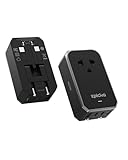
Overview: The EPICKA Air 40W adapter balances compact design with modern charging demands, offering a 5-in-1 solution for international travelers. This sleek unit provides one AC outlet and four USB ports including a powerful 40W PD USB-C connection, covering over 200 countries with its four plug types.
What Makes It Stand Out: The EPICKA Air achieves an impressive 40W PD output in an ultra-slim 3.15" x 1.97" x 1.19" profile with foldable prongs—making it one of the most portable fast-charging adapters available. The USB-C3 port maintains 20W PD even during multi-device charging, ensuring your primary device charges quickly. Its ability to fast-charge an iPhone to 50% in 20 minutes demonstrates real-world performance that matches larger chargers.
Value for Money: This adapter sits in the upper-mid price range but justifies the cost through its PD fast charging and extreme portability. Competitors with similar wattage are often bulkier and lack the foldable design. For travelers prioritizing minimalist packing without sacrificing charging speed, the premium is well-spent compared to carrying separate fast chargers.
Strengths and Weaknesses: Strengths: 40W PD fast charging; ultra-compact with foldable prongs; charges five devices; maintains PD during multi-charge; wide country coverage; modern aesthetic. Weaknesses: Only one AC outlet; not a voltage converter; 40W insufficient for large laptops; USB ports share power; no Quick Charge 3.0 on USB-A ports.
Bottom Line: An excellent choice for minimalist travelers with USB-C devices who value space-saving design. The 40W output and foldable prongs make it perfect for smartphones, tablets, and smaller laptops—just verify your devices support dual voltage before traveling.
10. European Travel Plug Adapter, LENCENT US to Europe Type-C Foldable Power Plug with 4 Outlets 4 USB Ports (2 USB C), Power Adaptor for USA to EU Euro Iceland Spain Italy France Germany Greece Portugal

Overview: The LENCENT European Adapter is a specialized 8-in-1 solution designed specifically for Type C European outlets. It transforms one European socket into four American AC outlets and four USB charging ports, making it ideal for travelers visiting multiple European countries who need to charge numerous devices simultaneously.
What Makes It Stand Out: This adapter’s 4-side design prevents blocking and allows charging up to eight devices at once without interference. The foldable plug design enhances portability while preventing scratches in your bag. With two USB-C ports (15W) and two USB-A ports (12W), it provides faster total USB output (17.5W) than many competitors. The 2500W max capacity at 250V handles most dual-voltage appliances safely.
Value for Money: Offering exceptional value for Europe-specific travel, this adapter eliminates the need for both a multi-port USB charger and a separate power strip. Its ability to charge eight devices from a single outlet means one person can power an entire family’s electronics. The sub-$20 price point makes it an affordable upgrade over basic single-outlet adapters.
Strengths and Weaknesses: Strengths: Charges eight devices simultaneously; foldable, compact design; 4-side non-blocking layout; fast USB charging; 2500W high capacity; no surge protection (cruise-friendly); lightweight at 4.2oz. Weaknesses: Europe-only (Type C); not a voltage converter; USB-C lacks PD fast charging; no Quick Charge 3.0; unsuitable for UK, Ireland, or Switzerland.
Bottom Line: Perfect for travelers focused on European destinations who need to charge multiple devices. The 8-in-1 design and compact form factor make it an unbeatable value for EU trips, provided your devices support dual voltage and you don’t require UK plug compatibility.
Understanding Travel Adapter Fundamentals
Before diving into compact designs, it’s essential to grasp what travel adapters actually do and why they’re non-negotiable for international travel. The technology might seem straightforward, but modern innovations have added layers of complexity that benefit savvy travelers.
What Is a Travel Adapter and Why Do You Need One?
A travel adapter is a simple yet crucial device that allows you to plug your electronics into wall outlets with different socket configurations than those in your home country. It doesn’t change voltage—it merely provides a physical bridge between your device’s plug and the foreign outlet. For minimalist packers, this single tool eliminates the need to carry multiple country-specific cables or devices.
The Difference Between Adapters and Converters
This distinction trips up even experienced travelers. An adapter changes the plug shape; a converter changes the voltage. Most modern electronics (phones, laptops, cameras) have built-in voltage converters in their power bricks, so they only need an adapter. However, simpler appliances like hair dryers or straighteners might require a full voltage converter. For minimalists, the key is knowing your devices—bringing only dual-voltage electronics means you can stick with a lightweight adapter and skip the heavy converter entirely.
Why Size Matters for Minimalist Travelers
The difference between a “compact” adapter and a truly minimalist one can mean the difference between a streamlined packing experience and a frustrating game of luggage Tetris. Understanding spatial efficiency goes beyond just looking at dimensions.
How Compact Is “Compact Enough”?
For true minimalist packing, the sweet spot lies in adapters that occupy less space than a standard smartphone and weigh under 100 grams. However, “compact” is relative to your specific setup. If you’re traveling with just a phone and earbuds, a single-port adapter smaller than a matchbox might suffice. For those with a laptop, camera, and multiple devices, slightly larger multi-port options that replace several chargers can paradoxically save more space overall.
Volume vs. Surface Area: The Real Space Savers
Smart minimalist design isn’t just about being small—it’s about being packable. A flat, credit card-shaped adapter might have a larger surface area but slides effortlessly into a laptop bag sleeve. Conversely, a cube-shaped adapter could create awkward empty spaces in your packing cubes. Consider how the adapter’s shape integrates with your existing packing system rather than just its raw measurements.
Key Features That Define Modern Adapters
The feature set of travel adapters has expanded far beyond simple plug conversion. Today’s devices incorporate charging technology that can eliminate multiple other items from your packing list.
Number of USB Ports: Quality Over Quantity
Minimalist packing is about strategic reduction, not deprivation. A single USB-C port with Power Delivery might charge your laptop, phone, and tablet sequentially, eliminating three separate chargers. However, if you frequently charge multiple devices overnight, two well-positioned ports could be more efficient than one. Consider your charging habits—do you plug everything in at once, or can you rotate devices?
USB-C PD (Power Delivery) Explained
Power Delivery is the minimalist’s secret weapon. This protocol allows a single port to intelligently distribute up to 100W of power, automatically adjusting to each device’s needs. For travelers in 2026, PD 3.0 or higher means you can charge a MacBook Pro at full speed, then seamlessly switch to your smartphone without carrying different wattage chargers. The technology has become so efficient that some adapters now deliver laptop-level charging from form factors smaller than a deck of cards.
GaN Technology: The Game Changer
Gallium Nitride (GaN) has revolutionized compact charging. This semiconductor material runs cooler and more efficiently than traditional silicon, allowing manufacturers to shrink adapter sizes by up to 50% while increasing power output. For minimalist packers, GaN adapters represent the ultimate win-win: more power in less space with less heat generation. The technology has matured enough that premium GaN adapters are now only marginally more expensive than their bulkier silicon counterparts.
Build Quality and Durability Considerations
A broken adapter in a foreign country is a minimalist’s nightmare—you can’t exactly pack a backup without defeating the purpose. Investing in robust construction pays dividends in peace of mind.
Materials That Last
Premium adapters now use high-impact polycarbonate or reinforced nylon instead of cheap plastics. These materials withstand drops, resist cracking in extreme temperatures, and maintain their structural integrity after hundreds of plug insertions. For minimalists, durability directly correlates with reliability—you’re carrying one item, so it must work flawlessly every time.
Certifications to Look For
CE, FCC, and RoHS certifications are table stakes, but true quality markers include UL certification and compliance with IEC 60884 international safety standards. These aren’t just bureaucratic checkboxes—they indicate that an adapter has undergone rigorous testing for sustained use. In 2026, look for adapters that also meet the newer USB-IF certification for Power Delivery, ensuring safe, standardized fast charging.
Safety Features That Protect Your Devices
When you’re carrying minimal gear, each device becomes more critical. A single power surge or short circuit could derail your entire trip, making safety features non-negotiable.
Overload Protection and Fuses
Sophisticated adapters now include auto-resetting fuses that trip during power spikes then restore automatically, eliminating the need to carry spare fuses or find replacements abroad. Look for models with at least 10A overload protection and surge suppression rated to 1000+ joules. This is especially crucial in regions with unstable power grids where voltage fluctuations are common.
Child Safety Shutters
While designed to protect curious children, these shutters also prevent dust and debris from entering the adapter during travel. The best designs use spring-loaded shutters that require equal pressure from both plug prongs to open, ensuring they stay closed in your bag. This seemingly minor feature can prevent short circuits caused by metal objects or moisture during transit.
Weight: The Ultimate Minimalist Metric
Every ounce matters when you’re living out of a 30-liter backpack. Understanding how weight impacts your travel experience helps prioritize features versus portability.
Grams Matter: The Ultralight Approach
The lightest functional adapters in 2026 tip the scales at just 35-45 grams—about the weight of two AA batteries. These featherweight champions typically offer single-port USB-C charging and support 4-5 plug types. For ultralight purists, this is the holy grail: an item so light you’ll forget it’s in your pack, yet powerful enough to keep your essential devices charged.
When Bigger Might Be Better
Paradoxically, a slightly heavier adapter (80-100 grams) that combines multiple functions could reduce your total pack weight. If an adapter with three ports and built-in plug variants replaces three separate chargers and two plug adapters, your net weight savings could be 200+ grams. The minimalist mantra applies to weight too: optimize your entire system, not just individual items.
Multi-Functionality: Doing More with Less
The most space-saving adapters are those that consolidate multiple travel necessities into a single device. This is where modern design truly shines for minimalists.
Integrated Cables: Pros and Cons
Some adapters now feature retractable or fold-away cables, eliminating the need to pack separate cords. While this saves space, it introduces a potential failure point—if the integrated cable fails, the entire adapter becomes useless. Detachable cables offer more flexibility but require separate packing. For minimalists, the decision hinges on your risk tolerance and whether you prefer all-in-one simplicity or modular redundancy.
The Swiss Army Approach: Adapters with Extras
Forward-thinking designs incorporate features like built-in phone stands, LED flashlights, or even small power banks. While these might seem gimmicky, they can replace other items in your kit. A 5,000mAh power bank integrated into an adapter adds only 20-30 grams but provides emergency backup power during long travel days. The key is evaluating whether these extras genuinely replace something you’d otherwise pack.
Design Aesthetics for the Discerning Minimalist
Minimalism extends beyond function to form. The visual and tactile experience of your gear matters, especially when you’re using it daily.
Color and Finish Options
Matte black and white remain popular for their ability to hide scuffs and blend with premium electronics. However, brighter colors offer practical benefits—they’re easier to spot in dim hotel rooms and less likely to be left behind. Some adapters now feature minimalist branding or no logos at all, appealing to travelers who prefer their gear to be functional without being billboard-like.
Minimalist Branding and Packaging
The most minimalist adapters come in simple, recyclable packaging with no unnecessary manuals or plastic inserts. The product itself often features subtle branding or a small, tasteful logo. This attention to detail reflects a design philosophy that aligns with minimalist values: focus on the essential, eliminate the superfluous.
Price vs. Value in the Compact Adapter Market
The cost of compact adapters spans a wide range, but price doesn’t always correlate with value for minimalist travelers. Understanding what you’re paying for helps make a strategic investment.
Budget Tiers: What to Expect
Entry-level compact adapters ($15-25) offer basic functionality but often skimp on safety certifications and use cheaper materials. Mid-range options ($30-50) represent the sweet spot for most minimalists, offering GaN technology, robust safety features, and durable construction. Premium adapters ($60-100) justify their cost through extreme miniaturization, higher power output (100W+), and exceptional build quality that could last a decade of constant travel.
Warranty and Support Value
A two-year warranty is standard, but some manufacturers now offer lifetime warranties or hassle-free replacement programs. For minimalists, this is crucial—knowing you can get a replacement shipped to your location provides peace of mind that justifies a higher upfront cost. Check whether the company has a reputation for honoring warranties internationally, not just domestically.
Common Mistakes Minimalist Travelers Make
Even seasoned light packers can fall into traps when selecting adapters. Avoiding these pitfalls saves both money and precious bag space.
Buying the Wrong Type for Your Destination
The universal adapter is a minimalist’s dream, but not all “universal” designs cover every country. Some omit the specific plug types used in South Africa, Switzerland, or Brazil. Always verify that the adapter works for your specific destinations rather than assuming “universal” means truly global. A quick check of your actual itinerary prevents carrying a useless piece of plastic.
Ignoring Power Requirements
That 35-gram adapter is perfect until you realize it only delivers 15W and your laptop needs 65W. Calculate your maximum single-device power need first, then ensure your adapter meets or exceeds it. For minimalists, the mistake isn’t just wasted space—it’s being unable to work because your dead laptop can’t charge.
Strategic Packing for Adapter Efficiency
How you pack your adapter is just as important as which one you choose. Smart strategies maximize space and protect your gear.
Strategic Adapter Placement
Store your adapter in an easily accessible pocket of your daypack rather than buried in your main luggage. You’ll need it during transit at airports and cafes. Some travelers use small pouches or rubber bands to keep the adapter attached to their charging cable, creating a single grab-and-go charging kit that never gets lost in bag depths.
The One-Bag Rule
If you can’t charge every device you carry with your single adapter (sequentially if needed), you’re carrying too many devices. This self-imposed rule forces honest evaluation of your electronics. For true minimalists, the adapter becomes the limiting factor that prevents tech creep—the gradual accumulation of unnecessary gadgets.
Future-Proofing Your 2026 Purchase
Technology moves fast, but a well-chosen adapter should serve you for multiple years and dozens of trips. Thinking ahead ensures longevity.
USB-C Is the Future (and Present)
By 2026, USB-C has become the de facto standard for everything from Android and Apple devices to cameras and headphones. An adapter with multiple USB-C ports is more future-proof than one with USB-A ports. However, include at least one USB-A port if you still own older devices, or plan to borrow chargers from others during your travels.
Assessing Your Travel Profile
Are you a city-hopper staying in modern hotels with stable power, or an adventure traveler visiting remote lodges with questionable electrical systems? The former can prioritize ultra-compact design, while the latter needs robust surge protection and wider voltage compatibility. Be honest about your travel style—your adapter should match your reality, not an aspirational version of your trips.
Making Your Final Decision
Selecting the perfect compact travel adapter is a personal calculation of your specific needs, destination requirements, and minimalist philosophy. There’s no universally perfect adapter, only the perfect one for your journey.
Creating Your Personal Checklist
Before purchasing, run through this minimalist-focused checklist: Does it charge my most power-hungry device? Is it lighter than the chargers it replaces? Will it work in every country on my itinerary? Does it have certified safety features? Can I afford to replace it if lost? If you answer “yes” to all five, you’ve found your ideal travel companion.
Frequently Asked Questions
What’s the difference between a travel adapter and a voltage converter?
A travel adapter simply changes the physical plug shape to fit foreign outlets, while a voltage converter actually transforms the electrical voltage. Most modern electronics have built-in voltage converters, so they only need an adapter. Simple heating appliances like hair dryers often require a separate voltage converter.
How many ports do I really need on a minimalist adapter?
For true minimalism, one powerful USB-C port with Power Delivery can suffice if you charge devices sequentially. However, two ports often provide the best balance—allowing you to charge your phone and headphones simultaneously while your laptop charges overnight. More than three ports usually adds unnecessary bulk.
Can a compact adapter really charge my laptop?
Yes, many modern GaN-based adapters deliver 65W to 100W from extremely compact forms. Check your laptop’s power requirements (usually printed on the charger) and ensure the adapter’s Power Delivery rating meets or exceeds that wattage. Most USB-C laptops charge perfectly well with 65W adapters.
What’s GaN technology and why should I care?
Gallium Nitride (GaN) is a semiconductor material that conducts electricity more efficiently than traditional silicon. This means adapters can be up to 50% smaller, generate less heat, and deliver more power. For minimalist travelers, GaN translates to more capability in less space.
Are universal adapters truly universal?
Most cover 150+ countries but may exclude specific types like South Africa’s large round pins or Switzerland’s unique recessed outlets. Always verify coverage for your exact destinations. “Universal” typically means Type A, B, C, E, F, G, I, and J plugs, which covers most of Europe, Asia, and the Americas.
How much should a minimalist travel adapter weigh?
The lightest functional adapters weigh 35-45 grams, but 60-80 grams is more typical for adapters with multiple ports and full universal coverage. The key is comparing the adapter’s weight against the weight of what it replaces—if it eliminates two chargers and a plug set, even 100 grams is a net win.
Is it worth paying more for a premium adapter?
For frequent travelers, yes. Premium adapters offer better safety certifications, more durable materials, higher power output, and longer warranties. A $70 adapter that lasts 5+ years and protects $2000+ worth of devices is a sound investment. Occasional travelers might find mid-range options sufficient.
Can I use my adapter on a cruise ship or airplane?
Cruise ships often use standard outlets but may have voltage restrictions—check with your cruise line. Airplanes typically have limited power outlets that may not accommodate universal adapters due to space constraints. Some compact adapters work, but it’s not their primary design purpose.
What’s the best way to pack a travel adapter to save space?
Store it in an easily accessible pocket of your daypack, ideally attached to your charging cable with a small pouch or rubber band. This creates a unified charging kit that’s grab-and-go. Avoid burying it in your main luggage where it’s hard to reach during transit.
How do I know if an adapter is safe and certified?
Look for UL certification, IEC 60884 compliance, and USB-IF certification for Power Delivery. Reputable brands list these certifications clearly. Avoid unbranded or suspiciously cheap adapters, as they may lack proper surge protection or use substandard materials that pose fire risks. When in doubt, buy from established manufacturers with clear warranty policies.