There’s a special kind of anxiety that bubbles up while waiting at baggage claim, watching the same black suitcase circle the carousel for the third time—not yours. With airlines mishandling millions of bags annually and travel disruptions becoming increasingly common, the modern traveler needs more than just a colorful ribbon to distinguish their luggage. Bluetooth trackers have emerged as the savvy traveler’s secret weapon, transforming the helpless wait into proactive monitoring. These pocket-sized devices don’t just help you locate lost items around the house; they’ve evolved into sophisticated travel companions that can pinpoint your checked bag’s location even when you’re thousands of miles away. But not all trackers are created equal, and understanding the nuanced features that matter specifically for air travel can mean the difference between a seamless reunion with your belongings and a frustrating game of digital hide-and-seek.
Top 10 Bluetooth Trackers for Checked Luggage
Detailed Product Reviews
1. Air Tracker Tag for Android 4 Pack(NOT iOS or Huawei), Bluetooth Tracker Android Item Finder Smart Tracker Luggage Tags, GPS Locator Device for Keys, Wallet,Bike, No Monthly Fee Smart Tag
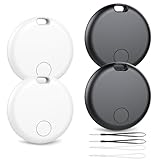
Overview: The Air Tracker Tag 4-Pack delivers Android-exclusive tracking via Google’s Find My Device ecosystem. Designed specifically for Android users (excluding Huawei devices), these tags help locate keys, wallets, luggage, and pets within a 40-meter Bluetooth range. Each tag features a built-in speaker for audible locating and integrates seamlessly with Android’s native tracking infrastructure for dependable daily use.
What Makes It Stand Out: Google certification ensures encrypted, anonymized communication with no location history stored on the device. The standout Sharing Mode lets family and friends assist in locating lost items, creating a collaborative recovery network. IP67 waterproofing and a user-replaceable CR2032 battery provide durability for outdoor adventures. Instant alerts trigger the moment an item disconnects from Bluetooth, offering proactive loss prevention.
Value for Money: At $39.99 for four units ($10 each), this sits in the mid-range category. While pricier than basic alternatives, the Google certification, robust privacy protections, and sharing features justify the premium over no-name competitors. It’s still significantly cheaper than premium brands like Tile Pro while offering comparable features.
Strengths and Weaknesses: Strengths include official Google integration, strong privacy encryption, IP67 rating, family sharing capability, and proactive alerts. Weaknesses include Android-only compatibility (no iOS or Huawei), a relatively modest 40-meter range, and a shorter 1-year battery life compared to some competitors offering two-year longevity.
Bottom Line: A reliable, privacy-focused choice for Android households needing multiple trackers. The sharing features and Google certification make it worth the modest premium over budget alternatives, especially for families.
2. ATUVOS Air Tracker Tags-4 Pack, Bluetooth Luggage Tracker Works with Apple Find My APP (iOS Only, Not for Android), Keys Finder and Item Locator for Luggage, Backpack, Suitcases, Replaceable Battery

Overview: ATUVOS offers a budget-friendly four-pack of AirTag alternatives exclusively for Apple’s ecosystem. These trackers leverage the vast Find My network, allowing iPhone users to locate items through hundreds of millions of Apple devices. The tags emit an 80-100 decibel ring—louder than many competitors—and integrate directly with Siri voice commands for hands-free operation and quick recovery.
What Makes It Stand Out: The exceptional loudness makes locating items between couch cushions or in noisy environments significantly easier. Seamless integration with Apple’s native Find My app means no third-party software or subscriptions. The four-pack configuration provides comprehensive coverage for keys, bags, bikes, and luggage at an aggressive price point that challenges generic competitors.
Value for Money: At $25.49 for four ($6.37 per unit), this represents one of the best values in the iOS tracker market—undercutting Apple’s AirTag by over 50% while delivering core functionality. No monthly fees and free Apple network access enhance long-term affordability for budget-conscious users seeking reliable tracking.
Strengths and Weaknesses: Strengths include loud speaker output, effortless Apple ecosystem integration, Siri compatibility, and excellent price-to-performance ratio. Weaknesses include iOS-only restriction, no explicit waterproof rating in the listing, and reliance on the Apple network’s 200-foot Bluetooth limitation for nearby finding capabilities.
Bottom Line: An outstanding AirTag alternative for iPhone users prioritizing value. The loudspeaker and seamless integration make it ideal for everyday item recovery without paying the Apple premium, though durability in wet conditions remains uncertain.
3. Tracker Tags-4 Pack, Bluetooth Tracker Works with Apple Find My APP (iOS Only), Keys Finder and Item Locator for Luggage, Backpack, Suitcases, Replaceable Battery, IP67 Waterproof weTag pro

Overview: The weTag Pro 4-Pack delivers essential Apple Find My functionality at an entry-level price point. These ultra-lightweight trackers (9 grams each) help iOS users locate keys, wallets, and luggage within a 60-meter Bluetooth range while tapping into Apple’s global device network for far-away recovery. The IP67 waterproof rating and two-year battery life promise durability and low maintenance for everyday use.
What Makes It Stand Out: At just $4.18 per unit, it’s the most economical way to protect multiple valuables with Apple’s secure network. The two-year battery life exceeds most competitors, including Apple’s own AirTag. The minimalist design features a smooth surface that won’t scratch belongings, and the instant Lost Mode leverages nearby Apple devices to relay contact information automatically when items go missing.
Value for Money: $16.71 for four trackers is exceptional value—costing less than a single AirTag. This makes comprehensive tracking accessible for students, families, or anyone needing multiple units without financial strain. The extended battery life further reduces long-term ownership costs significantly compared to annual replacement alternatives.
Strengths and Weaknesses: Strengths include unbeatable pricing, two-year battery life, IP67 waterproofing, lightweight design, and Apple network integration. Weaknesses include requiring iOS 18 for full functionality, potential quality control concerns at this price tier, and limited brand recognition for warranty support and customer service.
Bottom Line: The best budget option for iPhone users wanting maximum coverage with minimal investment. Perfect for tagging numerous items without breaking the bank, though early adopters should verify iOS 18 compatibility first to ensure full feature access.
4. Air Tags for Android,Air Tags-4 Pack Android,Air Tracker Tags with 4 Case,2 Year Battery Life,Google Find Trackers for Google’S Find Hub App,IP65 Waterproof Luggage Tracker for Key,4 Colour

Overview: This four-pack of Android-exclusive trackers offers a compelling middle-ground solution for Google ecosystem users. Compatible with Google’s Find Hub app, these tags provide global cloud positioning through Android’s growing device network. With an 85dB speaker and IP65 weather resistance, they balance audibility and durability for daily tracking of keys, wallets, and luggage across various scenarios.
What Makes It Stand Out: The two-year battery life is a major differentiator, doubling the longevity of many competitors and reducing maintenance hassles significantly. The IP65 rating provides adequate splash protection for most scenarios, while data encryption via Google’s infrastructure ensures privacy compliance. The four-color variety pack adds visual organization for different items or family members.
Value for Money: At $25.95 for four ($6.49 per unit), this positions itself as a cost-effective alternative to premium Android trackers like Tile. While slightly pricier than the absolute cheapest options, the extended battery life and Google integration justify the modest premium over generic no-name brands with uncertain support and reliability.
Strengths and Weaknesses: Strengths include exceptional two-year battery life, competitive pricing, loud 85dB alert, global cloud positioning, and data encryption. Weaknesses include the lower IP65 rating (vs. IP67), vague “Find Hub” app branding that may confuse users expecting “Find My Device,” and limited brand recognition compared to established competitors with proven track records.
Bottom Line: A solid choice for Android users prioritizing battery longevity and overall value. The two-year battery life makes it ideal for those wanting set-it-and-forget-it convenience, though water resistance is merely adequate rather than robust for heavy outdoor use.
5. Tracker Tags-3 Pack Work with Apple Find My (iOS Only), [Apple MFi Certified] Key Finder and Item Locator, New Bluetooth 5.3 Tracker, Replaceable Battery Smart Tag for Keys, Wallet, Luggage etc
![Tracker Tags-3 Pack Work with Apple Find My (iOS Only), [Apple MFi Certified] Key Finder and Item Locator, New Bluetooth 5.3 Tracker, Replaceable Battery Smart Tag for Keys, Wallet, Luggage etc](https://m.media-amazon.com/images/I/41MxpuQYMcL._SL160_.jpg)
Overview: The Mi Tracker 007 three-pack delivers MFi-certified Apple Find My integration at a budget price point. These trackers feature Bluetooth 5.3 for improved connectivity and power efficiency, helping iOS users locate essentials within the Apple network’s extensive range. The IP67 waterproof rating and 12-month battery life provide reliable protection for keys, wallets, and luggage in various conditions.
What Makes It Stand Out: Official MFi certification ensures full compatibility and reliable performance with Apple’s ecosystem—a rarity at this aggressive price tier. Bluetooth 5.3 offers better range and battery efficiency than older protocols. The compact, lightweight design integrates seamlessly with key rings and wallet pockets without adding noticeable bulk or weight to everyday carry items.
Value for Money: At $14.99 for three ($5 per unit), this offers certified quality nearly as cheap as uncertified alternatives. The MFi badge provides peace of mind that cheaper knockoffs can’t match, making it an exceptional value proposition for iPhone users wanting guaranteed compatibility without paying Apple’s premium pricing structure.
Strengths and Weaknesses: Strengths include official MFi certification, modern Bluetooth 5.3 technology, IP67 waterproofing, loud 80-100dB alert, and highly competitive pricing. Weaknesses include the shorter 12-month battery life versus some competitors offering two years, only three units per pack, and reliance on the Apple network’s inherent 200-foot Bluetooth limitation.
Bottom Line: The smartest choice for budget-conscious iPhone users who want guaranteed Apple compatibility. The MFi certification justifies choosing this over slightly cheaper uncertified alternatives, offering reliable performance and peace of mind at an accessible price point for most consumers.
6. UGREEN FineTrack Air Tracker Tags(iOS Only), 2-Year Replaceable Battery Bluetooth Tracker Compatible with Apple Find My, Item Finder Smart Tag for Keys, Luggage, Wallet - [Apple MFi Certified]
![UGREEN FineTrack Air Tracker Tags(iOS Only), 2-Year Replaceable Battery Bluetooth Tracker Compatible with Apple Find My, Item Finder Smart Tag for Keys, Luggage, Wallet - [Apple MFi Certified]](https://m.media-amazon.com/images/I/31cD0SQJyRL._SL160_.jpg)
Overview:
The UGREEN FineTrack Air Tracker Tags deliver Apple Find My compatibility at a fraction of the cost of official AirTags. Designed exclusively for iOS devices, these MFi-certified tags offer seamless integration with the Find My ecosystem, allowing you to locate keys, wallets, and luggage with a single tap. The four-pack provides comprehensive coverage for multiple valuables, while features like family sharing (iOS 17+) and Lost Mode enhance the tracking experience.
What Makes It Stand Out:
The standout feature is the two-year replaceable battery life, doubling the standard one-year lifespan of most competitors. The UL4200A child safety certification addresses critical safety concerns, while end-to-end encryption ensures your location data remains private. Unlike budget alternatives, the MFi certification guarantees reliable performance and seamless pairing with Apple’s network.
Value for Money:
At just $8.99, this 4-pack represents exceptional value—costing significantly less than a single AirTag. You’re getting Apple-certified tracking, extended battery life, and robust privacy features without subscription fees. For iOS users seeking AirTag functionality without the premium price, this is arguably the best budget alternative available.
Strengths and Weaknesses:
Strengths include the two-year battery, MFi certification, family sharing capabilities, child-safe design, and strong encryption. Weaknesses are the iOS-only limitation (no Android support), lack of Ultra Wideband precision finding, and potentially less polished software integration than first-party AirTags.
Bottom Line:
For iPhone users wanting reliable, certified tracking on a budget, the UGREEN FineTrack tags are a compelling choice. The extended battery life and safety certifications make them particularly attractive for families, though they lack the precision of premium alternatives.
7. Air Tracker -4 Pack, 2026 New Bluetooth Tracker Tags, Android Tracker Tags Work with Google Find Hub Device App, Bluetooth Luggage Tracker for Keys, Backpack,Suitcase,Travel
Overview:
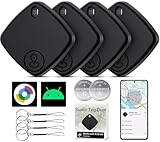
The Air Tracker 4-Pack positions itself as a 2026-upgraded solution exclusively for Android users seeking Google ecosystem integration. These tags work with the “Google Find Hub Device App,” leveraging Google’s network to locate keys, backpacks, and luggage. The four-pack design allows comprehensive coverage of multiple items, while the straightforward pairing process requires just a single tap near your Android device.
What Makes It Stand Out:
Unlike cross-platform trackers, this product focuses entirely on Android optimization. The integration with Google’s Find Hub network enables location tracking even when devices are offline, using nearby Android phones to update locations. The sleek, lightweight design attaches easily to keychains without adding bulk, while the latest Bluetooth technology promises reliable performance in crowded indoor environments.
Value for Money:
At $24.99 for four trackers, this package offers solid mid-range value. While more expensive than some no-name brands, it undercuts Apple AirTags significantly and provides Android-specific features that generic trackers lack. The one-year battery life on standard CR2032 cells is adequate, though not class-leading.
Strengths and Weaknesses:
Strengths include Android-exclusive optimization, Google ecosystem integration, offline functionality, and the convenient 4-pack configuration. Weaknesses are the iOS incompatibility, reliance on a less-established “Find Hub” app compared to Apple’s mature Find My network, and the standard one-year battery life. The product name’s “2026” branding feels gimmicky.
Bottom Line:
Android users wanting a native alternative to AirTags will find these trackers reasonably capable. The Google integration is promising, though the ecosystem’s maturity remains unproven compared to Apple’s established network.
8. NavmmSenn Android Tracker Tags 4 Pack Air Luggage Tracker Tags Compatible with Google Find Hub App (Android Only) Bluetooth Tracker Key Finder and Item Locator for Wallets, Backpack, Suitcases-Black
Overview:
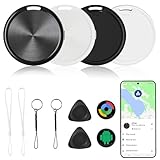
The NavmmSenn Android Tracker Tags cater specifically to Android 9+ users seeking a robust alternative to Apple’s ecosystem. This four-pack integrates with Google’s Find Hub App, using Bluetooth signals from nearby Android devices to locate lost items like wallets, backpacks, and suitcases. The system operates even when offline, updating location when reconnected to the network.
What Makes It Stand Out:
The 100dB alarm volume significantly exceeds typical tracker speakers, making it ideal for finding items buried in sofas or noisy environments. The product emphasizes privacy with encrypted location data transmitted through Google’s network. Its straightforward pop-up pairing process simplifies setup, while the included lanyards enhance attachment versatility.
Value for Money:
Priced at $29.99 for four units, these tags sit at the higher end of third-party trackers. The premium is justified by the exceptionally loud speaker and focused Android optimization. However, the price gap narrows with official options, making the value proposition dependent on how much you prioritize volume over ecosystem maturity.
Strengths and Weaknesses:
Strengths include the powerful 100dB alert, 12-month replaceable battery, strong privacy encryption, and simple pairing mechanism. Weaknesses are the restrictive Android-only compatibility (explicitly excluding Huawei devices), higher price point, and dependence on Google’s less-mature Find Hub network compared to Apple’s Find My. The design is functional but less refined than premium alternatives.
Bottom Line:
For Android users who struggle with hearing standard tracker alerts, the NavmmSenn’s ear-piercing 100dB alarm is a game-changer. The premium price is worth it if volume is your priority, though ecosystem limitations remain a consideration.
9. 4 Pack Android Tracker Tags,Bluetooth Tracker Tags Both iOS and Android Android Smart Tags for Android with 4 Waterproof Keyrings,Tracker for Android Phones for Luggage,Wallet,Key,Suitcases

Overview:
This 4-pack Android Tracker Tag set distinguishes itself through true cross-platform compatibility, supporting both iOS and Android devices. The IP67 water-resistant design and included waterproof keyrings make these tags suitable for outdoor use and travel. With a 200-foot Bluetooth range and built-in speaker, the system offers basic tracking functionality for keys, wallets, and luggage without locking you into a single ecosystem.
What Makes It Stand Out:
Unlike most competitors that force platform choices, these tags work across operating systems, making them ideal for mixed-device households. The IP67 waterproof rating provides peace of mind for outdoor adventures or accidental exposure. The Lost Mode feature allows you to leave contact information for good Samaritans, while Siri integration adds convenience for iPhone users.
Value for Money:
At $17.99 for four waterproof trackers with keyrings, this package delivers outstanding versatility for the price. It undercuts platform-specific alternatives while offering broader compatibility. The one-year CR2032 battery life is standard, and the low-battery notifications prevent unexpected failures.
Strengths and Weaknesses:
Strengths include cross-platform support, IP67 waterproofing, included accessories, 200-foot range, and Lost Mode with contact sharing. Weaknesses are the lack of official Apple or Google certification, reliance on a proprietary app of unknown quality, and the 80-100dB speaker which is adequate but not exceptional. The tracking network is limited to Bluetooth range rather than leveraging global device networks.
Bottom Line:
For families with both iPhones and Android phones, these affordable, waterproof trackers offer unmatched flexibility. While they lack the sophisticated network effects of certified alternatives, the cross-platform design and included accessories make them a practical budget choice.
10. Apple AirTag 4 Pack. Keep Track of and find Your Keys, Wallet, Luggage, Backpack, and More. Simple one-tap Set up with iPhone or iPad

Overview:
The Apple AirTag 4-Pack represents the gold standard in item tracking for iOS users. These official Apple tags integrate seamlessly with the Find My app, leveraging Apple’s vast network of over a billion devices to locate lost items anywhere. Designed for keys, wallets, luggage, and backpacks, AirTags offer one-tap setup and can be shared with up to five people, making them perfect for tracking communal items like car keys or family luggage.
What Makes It Stand Out:
Precision Finding using Ultra Wideband technology is the killer feature, providing directional guidance with distance and haptic feedback on compatible iPhone models. This transforms searching from a vague “it’s nearby” to a guided treasure hunt. The Find My network’s sheer scale ensures location updates are frequent and reliable, while Apple’s privacy-first approach includes alerts for unwanted tracking.
Value for Money:
At $64.98 for four, AirTags command a significant premium over third-party alternatives. However, the investment delivers superior integration, the unmatched Find My network, and Precision Finding technology that competitors cannot replicate. For iOS users deeply invested in the ecosystem, the premium is justified by the seamless experience and proven reliability.
Strengths and Weaknesses:
Strengths include Precision Finding, massive network coverage, effortless setup, family sharing, robust privacy protections, and excellent build quality. Weaknesses are the high price, iOS-only compatibility, lack of included keyrings or adhesives (requiring separate purchases), and the standard one-year battery life which is shorter than some alternatives.
Bottom Line:
If you use an iPhone and want the most reliable, precise tracking experience available, accept no substitutes. The AirTag’s premium price delivers premium performance that’s worth every penny for those invested in Apple’s ecosystem.
How Bluetooth Trackers Work for Air Travel
Bluetooth trackers operate on a deceptively simple principle that becomes powerful through scale. Each device broadcasts a low-energy Bluetooth signal that can be detected by nearby smartphones running the tracker’s companion app. When your tagged luggage passes within range of any compatible device—whether it’s your phone, a fellow traveler’s, or even airport staff’s—the location is anonymously updated to a central server and relayed to you. This crowd-sourced network effect is what makes Bluetooth trackers exceptionally valuable for checked luggage, where your bag moves through a complex ecosystem of conveyor belts, tarmac vehicles, and cargo holds far beyond your personal Bluetooth range. Unlike GPS trackers that require direct satellite connectivity and significant battery power, Bluetooth trackers sip energy conservatively and leverage the millions of smartphones already in pockets around the world. Understanding this fundamental difference helps set realistic expectations: you’re not tracking in real-time like a James Bond movie, but rather receiving location breadcrumbs as your luggage encounters other network participants.
Why Your Checked Luggage Needs a Bluetooth Tracker
The statistics paint a sobering picture—airlines mishandle approximately 7 bags per 1,000 passengers, which translates to millions of delayed, damaged, or lost suitcases annually. While most eventually find their way home, the interim period of uncertainty can derail entire trips. A Bluetooth tracker fundamentally shifts your response from reactive to proactive. Instead of filing a report and hoping for the best, you can approach the baggage claim office with precise location data showing your bag’s last known position. This information proves invaluable for routing issues, where your luggage might be sitting in a different terminal, city, or even country. Beyond the practical recovery benefits, trackers provide psychological relief that shouldn’t be underestimated. The ability to check your app and confirm your bag made it onto your connecting flight can transform a layover from a stress-fest into a relaxing coffee break. For business travelers with critical materials, photographers with expensive equipment, or families managing multiple bags, this peace of mind becomes non-negotiable.
Key Features to Evaluate Before Buying
Signal Range and Penetration
Manufacturers love to advertise maximum range figures—often claiming 200-400 feet in open conditions. For luggage tracking, these numbers are largely meaningless. Your suitcase will be buried beneath other bags, encased in metal cargo holds, and potentially shielded by terminal infrastructure. What matters is real-world penetration capability, which depends on Bluetooth signal strength (measured in dBm) and antenna design. Look for trackers that specifically mention enhanced penetration or “long-range” modes, as these perform better when obstructed. The actual usable range in airport environments typically drops to 30-80 feet, but this is sufficient when your bag emerges onto a crowded carousel.
Battery Architecture and Longevity
The battery debate centers on two primary designs: replaceable coin cells versus integrated rechargeable batteries. For checked luggage, replaceable CR2032 batteries often prove superior because they can last 12-18 months and be swapped instantly during a layover if needed. Rechargeable models might require six-monthly charging cycles and could die mid-trip if you forget. Consider temperature extremes in cargo holds, which can accelerate battery drain. Some premium trackers include battery health indicators in their apps—an essential feature for pre-flight checks. The ideal tracker maintains at least 30% battery life after sitting idle for months, ready for your spontaneous weekend getaway.
Durability and Environmental Protection
Your tracker will experience everything your luggage does: violent baggage handler tosses, pressure changes at altitude, potential rain exposure on tarmac, and temperature swings from freezing cargo holds to hot tarmacs. Ingress Protection (IP) ratings quantify this resilience. IP67 means dust-tight and waterproof for 30 minutes at 1-meter depth—sufficient for most travel scenarios. IP68 offers even better water protection. Beyond ratings, examine the tracker’s construction: polycarbonate shells withstand impacts better than cheaper plastics, and ultrasonic welding prevents water ingress around seams. Some trackers include shock-absorption features specifically designed for the rigors of air travel.
Network Size and Global Density
A tracker’s individual range matters far less than its network’s global footprint. The mathematics are straightforward: if you’re using a tracker brand with 10 million daily active users worldwide, your luggage has exponentially better odds of being located than with a niche brand having 100,000 users. Network density varies dramatically by region—some networks dominate North America but falter in Asia or Eastern Europe. For international travelers, investigate network heat maps or user density statistics. The most robust networks maintain critical mass even in smaller airports, ensuring your bag’s signal gets picked up during that crucial 20-minute layover in a secondary hub.
Range Considerations: What to Realistically Expect
Bluetooth operates on the 2.4 GHz frequency band, which is excellent for penetrating non-metallic materials but struggles with metal—unfortunate given that airplane cargo holds are essentially metal boxes. Real-world testing shows that a tracker inside a standard hardshell suitcase loses 60-70% of its advertised range. When that suitcase is then placed inside a metal cargo container with dozens of other bags, effective range might drop to just 15-30 feet. This is precisely why network size trumps individual range. Your tracker doesn’t need to reach your phone from inside the plane; it needs to connect to the phone of the baggage handler standing nearby, or the passenger waiting at the adjacent gate. Understanding this reality helps you appreciate why features like “extended range mode” or “mesh network capabilities” are more valuable than raw distance claims. Some advanced trackers use adaptive power transmission, automatically boosting signal strength when they detect they’ve been stationary for extended periods—perfect for luggage that sits in holding areas.
Battery Life: The Long-Haul Factor
Battery performance in luggage trackers follows different rules than everyday item trackers. Your device might sit untouched in a closet for three months, then endure a 24-hour travel day with constant signal broadcasting in a high-density environment. This intermittent heavy-use pattern demands robust power management. CR2032 batteries typically deliver 200-300mAh capacity, which translates to roughly one year of normal use or about 3-4 weeks of continuous active scanning. Temperature is the silent battery killer—cargo holds can reach -10°C (14°F), reducing battery efficiency by 30-40%. Premium trackers compensate with temperature-compensated voltage regulators, but budget models may simply die mid-flight.
Consider the replacement logistics: can you find the specific battery type in a foreign airport? Does the tracker require proprietary tools to open? Some designs necessitate a paperclip or special pry tool, while others offer tool-free battery doors. The best luggage trackers include a small compartment for a spare battery, though this adds marginal weight. For rechargeable models, verify charging speed—a dead tracker that requires four hours to charge isn’t practical for a two-hour layover. Wireless charging compatibility becomes surprisingly useful in airports with charging pads.
Water Resistance and Durability Standards
The IP rating system provides crucial insight into a tracker’s survival odds, but the numbers require interpretation for travel contexts. IPX7 (water immersion) differs from IPX6 (powerful water jets)—the former matters if your bag sits in a puddle on wet tarmac, while the latter protects against driving rain. The first digit indicates dust protection, crucial for cargo hold environments filled with particulate debris. IP6X means complete dust protection, preventing microscopic particles from interfering with circuitry.
Beyond official ratings, examine real-world stress factors. Vibration from conveyor systems can loosen internal components over time. Pressure changes at altitude may affect waterproof seals if they’re not properly vented. Some trackers include pressure-equalization membranes borrowed from dive watch technology. Drop-test specifications matter—a tracker rated for 1.5-meter drops will survive baggage handler handling better than one tested at just 0.5 meters. The attachment method deserves equal scrutiny: a keyring loop that breaks under 10kg of force is useless when your bag is being hurled onto a cart.
Size and Weight: TSA and Airline Regulations
The FAA and TSA have specific rules about lithium batteries in checked luggage, but most Bluetooth trackers use such small amounts of lithium (under 0.3g in CR2032 batteries) that they’re explicitly exempt from dangerous goods declarations. However, size still matters for practical placement. Bulky trackers (over 40mm diameter) create noticeable lumps that can snag on clothing or get forcibly removed by overzealous security inspections. The sweet spot is 25-35mm diameter and under 8mm thickness—small enough to tuck into a lining seam yet large enough for a robust antenna.
Weight becomes critical when you’re fighting against strict baggage limits. A tracker weighing 15 grams adds negligible heft, but some ruggedized models approach 30 grams. For elite status travelers with 70-pound limits, this is irrelevant, but budget airline passengers facing 15-20kg restrictions must account for every gram. Some creative travelers embed trackers inside hollow luggage handle tubes or behind lining fabric, but this requires disassembly that might void warranties. Always verify that your placement doesn’t interfere with the tracker’s antenna performance—metal shielding inside the luggage frame can block signals entirely.
Network Size: The Power of Community Finding
The true magic of modern Bluetooth trackers lies in their crowdsourced network, which operates on a principle of passive cooperation. When you mark your luggage as “lost” in the app, it sends a silent signal to every compatible device in the network, asking them to keep an eye out. This isn’t a battery-draining active search—it simply means other users’ apps will anonymously report if they detect your tracker’s signature. The effectiveness scales exponentially with user density. In major hubs like Atlanta or Heathrow, where millions of travelers carry compatible devices, your bag might be located within minutes of landing. In smaller regional airports or developing countries, the network may be sparse.
Investigate the network’s growth trajectory—a stagnant user base suggests future obsolescence. Some manufacturers publish quarterly active user metrics, which is a transparency indicator. Cross-platform compatibility significantly expands effective network size. Trackers that work with both iOS and Android devices effectively double their detection opportunities. The most sophisticated networks implement relay features, where a detected signal can hop through multiple devices before reaching the server, extending reach in low-density areas. For international travelers, verify whether the network operates in mainland China, where regulatory restrictions have forced some tracker brands to disable features entirely.
Privacy and Security Features
Attaching a tracking device to your most personal possessions raises legitimate privacy concerns. Reputable manufacturers implement multiple layers of protection. At minimum, your tracker’s location data should be end-to-end encrypted, meaning even the company can’t access your luggage’s whereabouts. Look for trackers that randomize their Bluetooth identifiers every 15 minutes—this prevents malicious actors from stalking your movements by recognizing your tracker’s unique signature. The app should offer two-factor authentication to prevent account takeover, which would grant someone access to your location history.
Anti-stalking features have become industry standard: if an unknown tracker consistently moves with you, your phone should alert you. While designed to prevent misuse, this feature can trigger false positives when traveling with family members who also use trackers. The best apps allow you to whitelist certain trackers permanently. Data retention policies vary—some companies delete location history after 24 hours, others keep 30 days. For business travelers carrying sensitive materials, shorter retention periods reduce corporate espionage risks. GDPR compliance is non-negotiable for European travel, and CCPA compliance matters for California residents. Review the privacy policy for data sale clauses; premium trackers generally fund operations through hardware sales rather than selling your location data to third parties.
International Travel Considerations
Crossing borders introduces regulatory complexity that can render your tracker useless. Bluetooth operates on the 2.4 GHz ISM band, which is globally unlicensed, but transmission power limits vary. The US allows up to 10mW EIRP, while the EU permits 100mW—trackers designed for the US market might be non-compliant and unreliable in Europe. Some manufacturers sell region-specific firmware versions; verify yours supports international power profiles.
Battery disposal regulations differ dramatically. The EU requires separate collection of button cells under the Battery Directive, while many Asian countries have no formal recycling programs. Carrying spare batteries requires understanding local dangerous goods rules—while permitted in carry-on luggage, some Middle Eastern airlines prohibit loose batteries entirely. Language support in the companion app becomes crucial when you need to communicate with foreign airline staff about your tracker’s location. The most traveler-friendly apps offer offline map downloads for the top 100 global airports, preventing expensive roaming charges when locating your bag.
Currency conversion for subscription services can add 20-30% costs in some regions. Consider annual plans purchased in your home currency before traveling. Some networks throttle location updates in certain countries due to server costs—verify your destination isn’t on a restricted list. For frequent international travelers, trackers with eSIM-like capabilities that can switch regional networks automatically provide the most seamless experience.
Setup and App Experience
The initial pairing process should take under two minutes, but the real differentiator is ongoing usability. A well-designed luggage tracking app prioritizes battery optimization, recognizing that you’ll likely check your bag’s location only a few times per trip. It should offer customizable notifications: alerts when your bag is detected after a long absence (suggesting it made a flight), but not spam notifications every time you’re near your own suitcase at home. Family sharing features allow multiple travelers to monitor the same bag—a godsend for group trips. The interface should display signal strength history, helping you diagnose if poor placement is blocking connectivity.
Integration with flight tracking services represents the next frontier. Some apps automatically enter “travel mode” when they detect you’ve arrived at an airport, increasing scan frequency and disabling power-saving features temporarily. This contextual awareness prevents the common frustration of opening your app to see your bag’s location hasn’t updated in four hours because the tracker was in deep sleep mode. Look for apps that offer web-based access alongside mobile—if your phone dies during a layover, you can borrow a computer to locate your luggage. The ability to export location logs as PDF reports streamlines airline compensation claims, providing timestamped proof of mishandling.
Advanced Features Worth Paying For
Premium trackers differentiate themselves with capabilities that justify their higher price points. Ultra-Wideband (UWB) technology enables precision finding with directional arrows and distance estimates accurate to inches—transforming the search from “it’s somewhere in this terminal” to “it’s 15 feet to your left behind the pillar.” This feature requires a compatible smartphone but proves invaluable when your bag ends up in the oversized luggage office or a random corner of the baggage hall.
Geofencing allows you to define safe zones (your home, hotel) and receive alerts when your luggage enters or leaves these areas. For checked bags, this means knowing the moment your suitcase is loaded onto the carousel at your destination airport. Some trackers incorporate NFC chips that can display your contact information when tapped by an honest finder, creating a backup recovery method if the battery dies. Historical heatmaps showing your bag’s journey through the airport infrastructure can reveal which handlers consistently misroute luggage, giving you data to file targeted complaints.
The most sophisticated models include barometric pressure sensors that detect altitude changes, confirming your bag actually boarded the plane rather than being left in the terminal. This feature, combined with temperature logging, provides forensic evidence for insurance claims when airlines dispute responsibility. While these advanced capabilities add cost, they transform the tracker from a simple locator into a comprehensive luggage monitoring system.
Common Pitfalls and Mistakes to Avoid
Many travelers purchase trackers based on advertised range alone, a metric that matters least for checked luggage. A 400-foot range in open air translates to perhaps 30 feet inside a cargo hold, making network size infinitely more important. Another frequent error is ignoring subscription requirements—some trackers function only with active monthly plans that cost more than the device itself over two years. Always calculate the total cost of ownership over your expected travel frequency.
Placement mistakes doom otherwise perfect trackers. Tucking them deep inside padded clothing might seem protective, but it can attenuate the signal by 90%. Conversely, placing them in exterior pockets risks damage and theft. The optimal position is inside the luggage lining, near the top, where the antenna has minimal metal obstruction. Testing before travel is essential; many users discover their chosen spot yields poor connectivity only after their bag is lost. Don’t forget to check local regulations—some countries, particularly in the Middle East, have banned certain tracker brands due to security concerns. Arriving at customs with a prohibited device can result in confiscation or fines.
Compatibility oversights cause frustration. A tracker designed exclusively for iOS won’t help if your family uses Android devices to search. Similarly, some trackers require the latest Bluetooth 5.2 standard, which older phones lack. Verify your phone will receive alerts for unknown trackers moving with you—without this anti-stalking feature, a malicious actor could slip a tracker into your bag. Finally, many travelers forget to disable separation alerts before checking their bag, resulting in dozens of panic-inducing notifications as they board the plane.
Best Practices for Placement in Your Luggage
Optimal placement balances signal propagation with physical protection. The ideal location is inside the main compartment, pressed against the interior lining near the top of the suitcase. This position avoids the metal frame and telescoping handle mechanism while keeping the tracker close to the exterior where signals can escape. If your luggage has a zippered interior pocket along the top edge, that’s prime real estate. For soft-sided bags, placing the tracker in a pocket that faces outward when the bag is upright maximizes detection chances.
Consider using two trackers for redundancy: a primary tracker in the main compartment and a backup hidden in the lining. This strategy accounts for battery failure, damage, or rare instances where security removes a visible tracker. When embedding trackers in lining, use a small fabric pouch or waterproof bag to prevent the hard plastic from wearing through the material over time. Avoid placing trackers near liquids—while water-resistant, they’re not designed to survive shampoo explosions.
Document your tracker’s serial number and identifier separately from the device. If your luggage is truly lost and you need to file a claim, providing the airline with the tracker’s unique ID can help them locate it in their system. Some frequent flyers create small cards that say “This bag contains a Bluetooth tracking device” with the tracker type and their contact info, placed in an exterior pocket. This transparency can prevent security concerns if the bag is screened. Finally, after each trip, check the tracker’s battery status and clean any debris from the speaker grille to ensure the alert sound remains audible.
Frequently Asked Questions
Will a Bluetooth tracker work if my luggage is on a different continent?
Yes, through the power of crowdsourced networks. Your tracker doesn’t need to connect directly to your phone. When any traveler with the same tracker’s app installed comes within Bluetooth range of your bag, their phone anonymously reports its location. In major international airports, this typically happens within hours of arrival. However, effectiveness depends on the network’s user density in that region—some brands have sparse coverage in Africa or parts of Asia.
Are Bluetooth trackers allowed by airlines and TSA?
Absolutely. The TSA explicitly permits Bluetooth trackers in both carry-on and checked luggage. The tiny lithium batteries (typically under 0.3 grams) are exempt from dangerous goods restrictions. However, individual airlines may have policies about active electronic devices in checked bags. Most allow them, but low-cost carriers sometimes prohibit anything with a battery. Check your specific airline’s prohibited items list before flying.
What’s the difference between Bluetooth trackers and GPS trackers for luggage?
GPS trackers use satellite signals for real-time location anywhere on Earth, requiring large batteries and monthly cellular subscriptions. They’re overkill for luggage—bulky, expensive, and often prohibited in checked bags due to larger lithium batteries. Bluetooth trackers use low-energy signals and crowdsourced detection, making them smaller, cheaper, and compliant with aviation regulations. They excel at airport and urban environments but can’t track your bag in the middle of the ocean.
Do I need a subscription for my luggage tracker to work?
It depends on the brand’s business model. Some trackers work indefinitely without fees, funding operations through hardware sales. Others require subscriptions for advanced features like international roaming, extended location history, or insurance integration. Basic location tracking usually works without payment, but you may lose features like separation alerts or family sharing. Calculate the two-year total cost before purchasing.
How accurate are Bluetooth trackers in busy airports?
Surprisingly accurate for “near me” detection, less so for precise coordinates. In a crowded terminal, your tracker might be detected within a 30-50 foot radius—enough to confirm it’s on the correct carousel but not which exact bag. Ultra-Wideband-enabled trackers can narrow this to inches, showing direction and distance. Standard models require you to trigger a sound alert and listen for the chirp, which can be challenging in noisy baggage halls.
Can I use a Bluetooth tracker in my carry-on instead?
Yes, and many travelers do for laptops and cameras. However, carry-on tracking is less critical since you maintain physical possession. The real value emerges for checked luggage that’s out of your control. Some travelers use separate trackers for each: a GPS-enabled tracker in carry-on for real-time mapping during the flight (in airplane mode), and a Bluetooth tracker in checked luggage for airport detection.
What happens if the tracker’s battery dies during my trip?
You’re essentially back to traditional lost luggage protocols. This is why battery management is crucial. Always check battery status 24 hours before departure. Carry a spare battery and the tool needed to replace it. For multi-week trips, consider trackers with replaceable batteries rather than rechargeable models. Some premium trackers include a tiny LED that flashes red when battery drops below 20%, providing visual warning even if you haven’t opened the app recently.
Are there any luggage trackers that work without a smartphone?
Not effectively. Bluetooth trackers fundamentally rely on smartphone apps for both setup and location reporting. Some brands offer web interfaces for viewing location history, but initial pairing always requires a mobile device. For travelers without smartphones, GPS trackers with built-in SIM cards and web portals exist, but they’re significantly more expensive and may violate airline battery policies.
Can airlines refuse to transport luggage with a tracker?
Extremely rare, but possible with certain carriers. A handful of ultra-low-cost airlines in Southeast Europe and the Middle East have prohibited active electronic devices in checked bags due to fire concerns. These policies target larger batteries, but enforcement can be inconsistent. If flying these carriers, place the tracker in your carry-on. Major international airlines (Delta, United, Lufthansa, Emirates, etc.) explicitly welcome trackers and some even partner with tracker companies.
How many trackers should I put in one piece of luggage?
One well-placed tracker is sufficient for most travelers. Redundancy becomes valuable for irreplaceable contents (medical equipment, film gear) or for multi-stop international itineraries. Using two different brands maximizes network coverage—if one brand’s network is weak in a region, the other might prevail. Just ensure they don’t physically interfere with each other; separate them by at least 12 inches to prevent signal overlap that can cause detection issues.'